Set.prototype.isSubsetOf()
Baseline
2024
Newly available
Since June 2024, this feature works across the latest devices and browser versions. This feature might not work in older devices or browsers.
The isSubsetOf() method of Set instances takes a set and returns a boolean indicating if all elements of this set are in the given set.
Syntax
isSubsetOf(other)
Parameters
Return value
true if all elements in this set are also in the other set, and false otherwise.
Description
In mathematical notation, subset is defined as:
And using Venn diagram:
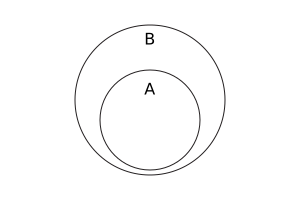
Note:
The subset relationship is not proper subset, which means isSubsetOf() returns true if this and other contain the same elements.
isSubsetOf() accepts set-like objects as the other parameter. It requires this to be an actual Set instance, because it directly retrieves the underlying data stored in this without invoking any user code. Then, its behavior depends on the sizes of this and other:
- If there are more elements in
thisthanother.size, then it directly returnsfalse. - Otherwise, it iterates over the elements in
this, and returnsfalseif any elementeinthiscausesother.has(e)to return a falsy value. Otherwise, it returnstrue.
Examples
Using isSubsetOf()
The set of multiples of 4 (<20) is a subset of even numbers (<20):
const fours = new Set([4, 8, 12, 16]);
const evens = new Set([2, 4, 6, 8, 10, 12, 14, 16, 18]);
console.log(fours.isSubsetOf(evens)); // true
The set of prime numbers (<20) is not a subset of all odd numbers (<20), because 2 is prime but not odd:
const primes = new Set([2, 3, 5, 7, 11, 13, 17, 19]);
const odds = new Set([3, 5, 7, 9, 11, 13, 15, 17, 19]);
console.log(primes.isSubsetOf(odds)); // false
Equivalent sets are subsets of each other:
const set1 = new Set([1, 2, 3]);
const set2 = new Set([1, 2, 3]);
console.log(set1.isSubsetOf(set2)); // true
console.log(set2.isSubsetOf(set1)); // true
Specifications
| Specification |
|---|
| ECMAScript® 2027 Language Specification # sec-set.prototype.issubsetof |
Browser compatibility
| desktop | mobile | server | |||||||||||||
|---|---|---|---|---|---|---|---|---|---|---|---|---|---|---|---|
isSubsetOf
|
|
|
|
|
|
|
|
|
|
|
|
|
|
|
|
Legend
Tip: you can click/tap on a cell for more information.
- Full support
- Full support