<position-area> CSS type

Baseline 2026 *
Newly available

Since January 2026, this feature works across the latest devices and browser versions. This feature might not work in older devices or browsers.

* Some parts of this feature may have varying levels of support.

The <position-area> CSS data type defines the cell or spanned cells of a position-area grid, a 3x3 grid whose center cell is an anchor element.

The <position-area> keyword values can be set as the value of the position-area property to place an anchor-positioned element in a specific location relative to its associated anchor element.

Syntax

<position-area> = [
  [ left | center | right | span-left | span-right | x-start | x-end | span-x-start | span-x-end | self-x-start | self-x-end | span-self-x-start | span-self-x-end | span-all ]
||
  [ top | center | bottom | span-top | span-bottom | y-start | y-end | span-y-start | span-y-end | self-y-start | self-y-end | span-self-y-start | span-self-y-end | span-all ]
|
  [ block-start | center | block-end | span-block-start | span-block-end | span-all ]
||
  [ inline-start | center | inline-end | span-inline-start | span-inline-end | span-all ]
|
  [ self-block-start | self-block-end | span-self-block-start | span-self-block-end | span-all ]
||
  [ self-inline-start | self-inline-end | span-self-inline-start | span-self-inline-end | span-all ]
|
  [ start | center | end | span-start | span-end | span-all ]{1,2}
|
  [ self-start | center | self-end | span-self-start | span-self-end | span-all ]{1,2}
]

Description

Position areas work on the concept of a position-area grid, a 3x3 grid of tiles composed of four grid lines, two on each axis, with an anchor element being the center tile:
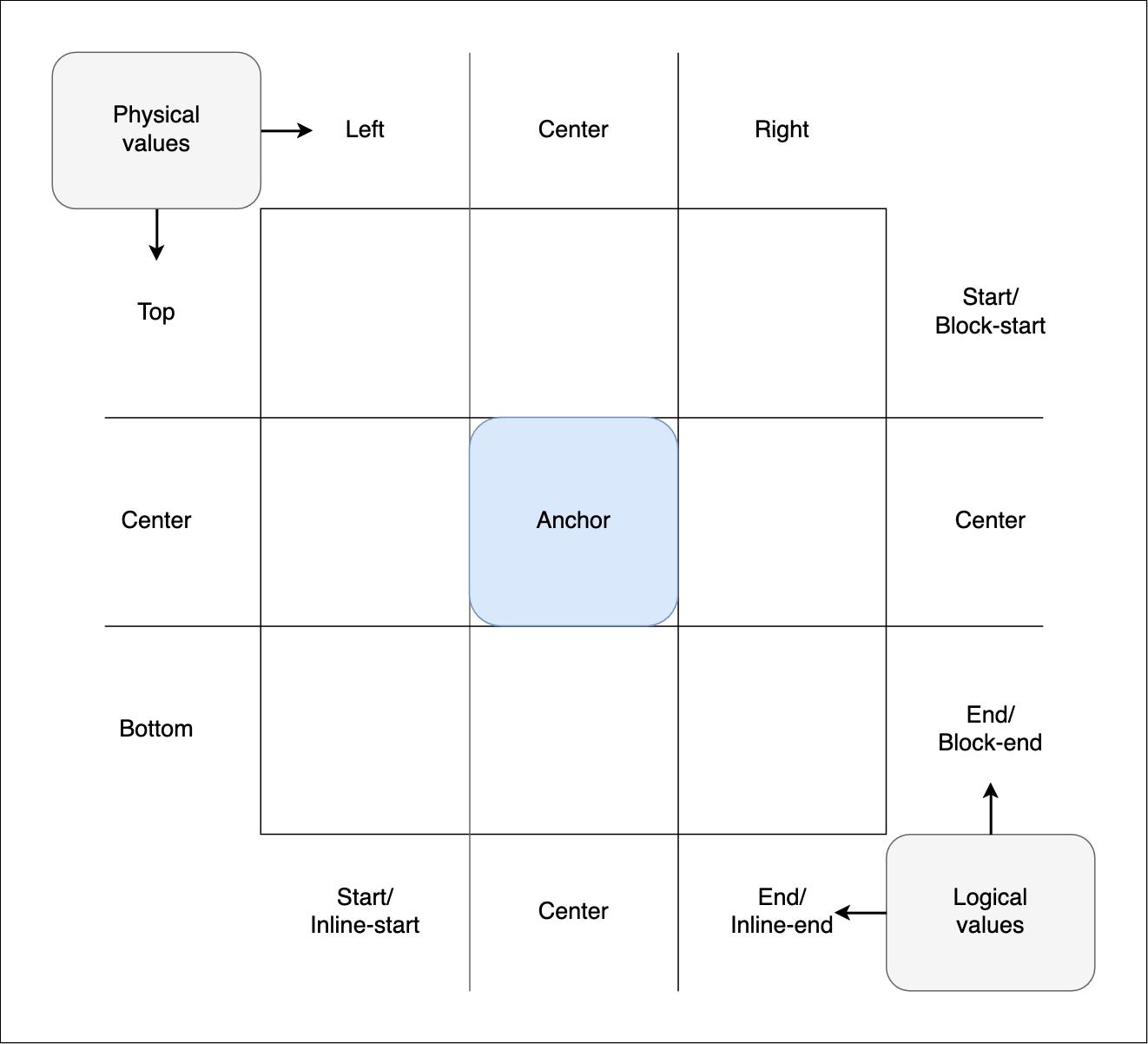
The position-area grid, as described below

When used as the value of a positioned element's position-area property, the dimensions of the center tile are defined by the containing block of the element's default anchor element. The dimensions of the grid's outer edge are defined by the positioned element's containing block. Logical keyterms are generally based on the writing mode and direction of the containing block, except for the self-* keyterms, which are calculated from the writing mode of the anchor-positioned element.

The grid tiles are broken up into rows and columns:

  • The three rows are represented by the physical values top, center, and bottom. They also have logical equivalents such as block-start, center, and block-end, and coordinate equivalents — y-start, center, and y-end.
  • The three columns are represented by the physical values left, center, and right. They also have logical equivalents such as inline-start, center, and inline-end, and coordinate equivalents — x-start, center, and x-end.

<position-area> values contain one or two keywords defining a specific area of the position-area grid. Setting a position-area value on a positioned element places its containing block in the specified grid area:

css
/* Examples: Two keywords to place the element in a single specific tile */
position-area: top left;
position-area: bottom right;
position-area: start end;
position-area: center end;
position-area: block-start center;
position-area: inline-start block-end;
position-area: x-start y-end;
position-area: center self-y-end;

/* Examples: Two keywords to span the element across two tiles */
position-area: top span-left;
position-area: span-bottom right;
position-area: center span-start;
position-area: inline-start span-block-end;
position-area: y-start span-x-end;

/* Examples: Two keywords to span the element across three tiles */
position-area: top span-all;
position-area: block-end span-all;
position-area: self-x-start span-all;

/* Examples: One keyword with an implicit second keyword  */
position-area: top; /* equiv: top span-all */
position-area: inline-start; /* equiv: inline-start span-all */
position-area: center; /* equiv: center center */
position-area: span-all; /* equiv: center center */
position-area: start; /* equiv: start start */
position-area: end; /* equiv: end end */

The different types of keywords that can be used include:

Note: Generally, you can't mix different types in one value, e.g., physical and logical. To do so results in invalid values. For example, position-area: bottom inline-end is not a valid value because it mixes physical and logical keywords.

Physical grid keywords

The physical grid keywords specify a cell or section of the position-area grid using physical values. These values are not affected by writing-mode or direction settings.

With physical row and column keywords, you can specify one keyword from each of the two lists below to select a single specific grid tile:

  • top, center, or bottom: The top, center, or bottom row of the grid.
  • left, center, or right: The left-hand, center, or right-hand column of the grid.

For example, top left selects the top left tile, while center right selects the center tile of the right-hand column.

Physical spanning grid keywords

The physical spanning keywords — when combined with a physical row or column keyword — specify a second grid tile for the position area to expand into. When such a combination is set as a position-area property value, a selected element is initially placed in the center of the specified row or column; it then spans in the direction specified in the spanning keyword, spanning two grid tiles:

span-left

Span the center column and the left-hand column of the grid.

span-right

Span the center column and the right-hand column of the grid.

span-top

Span the center row and the top row of the grid.

span-bottom

Span the center row and the bottom row of the grid.

span-all

Valid with all the keyword types, spans the cell listed as well as the adjacent cells in the same row or column. See span-all below.

For example, top span-left spans the top-center and top-left grid cells.

Note: Trying to pair a row or column keyword with an inappropriate spanning keyword will result in an invalid value. For example, right span-right is invalid — you can't select the center-right grid tile and then try to span further to the right.

Physical grid keyword defaults

If only a single physical keyword is specified in the position-area value, the other value is implied as follows:

left, right, top, or bottom

The other value defaults to span-all, causing the element to span all three tiles of the column or row it was initially placed in. For example, left is equivalent to left span-all.

center, span-left, span-right, span-top, or span-bottom

The other value defaults to center. For example, span-left is equivalent to center span-left and center is equivalent to center center.

Logical grid keywords

The logical grid keywords specify an area of the position area grid using logical values. With these values, the position and direction are affected by writing-mode and direction settings on either the element's containing block or, in the case of the self keywords, the positioned element itself. There are two types of logical keywords; generic and explicit.

Generic logical row and column keywords

The generic logical keywords use the same terms for the inline and block directions, with the direction determined by the position of the keyterm within a pair of <position-area> values. The first value defines the block direction position and the second value defines the inline value. You can specify one or two keyterms from the following list. Specifying two from this list defines a single specific grid tile. The keyword position or direction is:

start

The start of the grid's block or inline direction, calculated from the containing block's writing mode.

end

The end of the grid's block or inline direction, calculated from the containing block's writing mode.

self-start

The start of the grid's block or inline direction, calculated from the element's own writing mode.

self-end

The end of the grid's block or inline direction, calculated from the element's own writing mode.

center

The center of the grid's block direction (if this keyword is specified first) or inline direction (if this keyword is specified second).

For example, start end and self-start self-end both describe the position at the start of the block direction and the end of the inline direction. With writing-mode: horizontal-tb set, this is the top right of the anchor element, whereas with writing-mode: vertical-rl it is the bottom right of the anchor.

Generic logical spanning row and column keywords

The generic logical spanning keywords — when combined with a logical row or column keyword — specify a second grid tile for the position area to expand into. When such a combination is set as a position-area property value, a selected element is initially placed in the center of the specified row or column, and it then spans in the direction specified in the spanning keyword, spanning two grid tiles:

span-start

Span the center tile and the start tile of the grid row/column, with the direction referring to the writing mode of the element's containing block.

span-end

Span the center tile and the end tile of the grid row/column, with the direction referring to the writing mode of the element's containing block.

span-self-start

Span the center tile and the start tile of the grid row/column for the positioned element's own writing mode.

span-self-end

Span the center tile and the end tile of the grid row/column, calculated from the element's own writing mode.

For example, start span-end and self-start span-self-end both specify a grid position area that starts in the center of the start block row, and spans across the tiles in that row that sit in the inline center and end columns. With writing-mode: horizontal-tb set, this would span over the top center and top right of the anchor, whereas with writing-mode: vertical-rl set it would span the element over the right center and bottom right.

Explicit inline and block logical keywords

The explicit inline and block logical row and column keywords refer explicitly to a block (row) or inline (column) position. You can specify one keyword for the block direction and one for the inline direction to select a single specific grid tile. Unlike with generic logical keyword values, the keyword order doesn't matter. However, declaring two keywords in the same axis invalidates the value.

block-start

The start of the grid's block direction calculated from the containing block's writing mode.

block-end

The end of the grid's block direction calculated from the containing block's writing mode.

inline-start

The start of the grid's inline direction calculated from the containing block's writing mode.

inline-end

The end of the grid's inline direction calculated from the containing block's writing mode.

For example, block-start inline-end specifies the tile at the start of the block direction and the end of the inline direction. With writing-mode: horizontal-tb set, this would be the tile at the top-right of the anchor, whereas with writing-mode: vertical-rl set this would be the tile at the bottom-right.

Note: The specification defines self equivalents of these keywords — block-self-start, block-self-end, inline-self-start, and inline-self-end. However, these are not currently supported in any browser.

Explicit inline and block logical spanning keywords

The explicit logical spanning keywords — when combined with a logical row or column keyword — specify a second grid tile for the position area to expand into. When such a combination is set as a position-area property value, a selected element is initially placed in the center of the specified row or column, based on the containing block's writing mode, and it then spans in the direction specified in the spanning keyword, spanning two grid tiles:

span-block-start

Span the center tile and the block-start tile of the specified inline column.

span-block-end

Span the center tile and the block-end tile of the specified inline column.

span-inline-start

Span the center tile and the inline-start tile of the specified block row.

span-inline-end

Span the center tile and the inline-end tile of the specified block row.

For example, block-end span-inline-start selects the center tile of the end block row and spans across the tiles in that row that sit in the inline center and start columns. With writing-mode: horizontal-tb set, this would span the bottom-center and bottom-left grid tiles, whereas with writing-mode: vertical-rl set it would span the left-center and top-left grid tiles.

Note: The specification defines self equivalents of these keywords, for example — span-self-block-start, span-self-block-end, span-self-inline-start, and span-self-inline-end. However, these are not currently supported in any browser.

Note: Trying to pair a row or column keyword with an inappropriate spanning keyword will result in an invalid property value. For example, block-end span-block-end is invalid — you can't select the center block-end row and then try to span one tile further past the block end direction.

Logical grid keyword defaults

If only a single logical <position-area> keyword is specified, the other value is implied as follows:

start, end, self-start, or self-end

The other value defaults to the same as the first value, selecting the grid cell at the start row and column, or the end row and column.

span-start, span-self-start, span-end, span-self-end

The other value defaults to center. For example, span-start is equivalent to span-start center.

block-start, block-end, inline-start, inline-end

The other value defaults to span-all, spanning all three tiles of the column or row set. For example, block-start is equivalent to block-start span-all.

span-block-start, span-block-end, span-inline-start, span-inline-end

The other value defaults to center. For example, span-inline-start is equivalent to span-inline-start center.

Coordinate grid keywords

These keywords specify the cells of the position-area grid using x- and y-coordinate values. Its position/direction will be affected by writing-mode and/or direction settings on either an element's containing block or, in the case of the self keywords, the element itself.

However, the grid cells are defined according to physical axes rather than block/inline directions:

  • For writing-mode: horizontal-tb and vertical-lr, the x-axis runs left-to-right and the y-axis runs top-to-bottom.
  • For writing-mode: horizontal-tb; direction: rtl and writing-mode: vertical-rl, the x-axis runs right-to-left and the y-axis runs top-to-bottom.

With coordinate row and column keywords, you can specify one keyword from the x-axis and one from the y-axis to define a single specific grid tile.

The x-axis keywords include:

x-start

The start tile along the grid's x-axis, calculated from the containing block's writing mode.

x-end

The end tile along the grid's x-axis, calculated from the containing block's writing mode.

self-x-start

The start tile along the grid's x-axis, calculated from the element's own writing mode.

self-x-end

The end tile along the grid's x-axis, calculated from the element's own writing mode.

center

The center of the grid's x-axis, calculated from the element's own writing mode.

The y-axis keywords include:

y-start

The start tile along the grid's y-axis, calculated from the containing block's writing mode.

y-end

The end tile along the grid's y-axis, calculated from the containing block's writing mode.

self-y-start

The start tile along the grid's y-axis, calculated from the element's own writing mode.

self-y-end

The end tile along the grid's y-axis, calculated from the element's own writing mode.

center

The center of the grid's y-axis, calculated from the element's own writing mode.

For example, x-end y-start and self-x-end self-y-start both select the grid cell at end of the x-axis and the start of the y-axis. With writing-mode: horizontal-tb set, this would be the cell to the top right of the anchor, whereas with writing-mode: vertical-rl is at the top left.

Coordinate spanning keywords

When combined with a coordinate row or column keyword, the coordinate-spanning keywords specify a second grid tile for the position area to expand into. When such a combination is set as a position-area property value, a selected element is initially placed in the center of the specified row or column, and it then spans in the direction specified in the spanning keyword, spanning two grid tiles:

span-x-start

Span the center tile and the x-start tile of the specified y-axis row.

span-x-end

Span the center tile and the x-end tile of the specified y-axis row.

span-y-start

Span the center tile and the y-start tile of the specified x-axis column.

span-y-end

Span the center tile and the y-end tile of the specified x-axis column.

For example, y-end span-x-end selects the tile at the center of the end y-row, and spans across the tiles in that row that sit in the x-center and x-end columns. With writing-mode: horizontal-tb set, the position grid area would span the grid tiles at the bottom-center and bottom-right, whereas with writing-mode: vertical-rl set it would span the bottom-center and bottom-left tiles.

Note: The specification doesn't define separate coordinate self spanning keywords, but these are not needed — the spanning keywords can be used with both coordinate row and column keywords.

Coordinate grid keyword defaults

If only a single coordinate grid <position-area> keyword is specified, the other value is implied as follows:

x-start, self-x-start, x-end, self-x-end, y-start, self-y-start, y-end, or self-y-end

The other value defaults to span-all, selecting the grid tiles spanning all three tiles of the column or row it was initially placed in. For example, x-start is equivalent to x-start span-all.

span-x-start, span-x-end, span-y-start, span-y-end, span-self-x-start, span-self-x-end, span-self-y-end, or span-self-y-start

The other value defaults to center. For example, span-start is equivalent to span-start center.

span-all

span-all is a special keyword usable with all of the row and column keywords listed in the sections above. When you specify two values — a row/column keyword and span-all, the element is placed in the specified row or column, and it then spans all of the tiles in that row or column.

Examples

See the position-area property page.

For detailed information on anchor features and usage, see the CSS anchor positioning module and the Using CSS anchor positioning guide.

Specifications

Specification
CSS Anchor Positioning Module Level 1
# position-area

Browser compatibility

desktop mobile
Chrome
Edge
Firefox
Opera
Safari
Chrome Android
Firefox for Android
Opera Android
Safari on iOS
Samsung Internet
WebView Android
WebView on iOS
position-area
Chrome – No support
Chrome 125 – 130 (Release date: 2024-05-14)
altname
footnote Removed in 131 and later
altname Alternate name: inset-area
Chrome – Full support
Chrome 129 (Release date: 2024-09-17)
footnote
footnote The position-area property changes the position of absolutely positioned elements that do not find an anchor. See bug 388575663.
Edge – No support
Edge 125 – 130 (Release date: 2024-05-17)
altname
footnote Removed in 131 and later
altname Alternate name: inset-area
Edge – Full support
Edge 129 (Release date: 2024-09-19)
footnote
footnote The position-area property changes the position of absolutely positioned elements that do not find an anchor. See bug 388575663.
Firefox – Full support
Firefox 147 (Release date: 2026-01-13)
footnote Full support
Opera – No support
Opera 111 – 115 (Release date: 2024-06-12)
altname
footnote Removed in 116 and later
altname Alternate name: inset-area
Opera – Full support
Opera 115 (Release date: 2024-11-27)
footnote
footnote The position-area property changes the position of absolutely positioned elements that do not find an anchor. See bug 388575663.
Safari – Full support
Safari 26 (Release date: 2025-09-15)
footnote Full support
Chrome Android – No support
Chrome Android 125 – 130 (Release date: 2024-05-14)
altname
footnote Removed in 131 and later
altname Alternate name: inset-area
Chrome Android – Full support
Chrome Android 129 (Release date: 2024-09-17)
footnote
footnote The position-area property changes the position of absolutely positioned elements that do not find an anchor. See bug 388575663.
Firefox for Android – Full support
Firefox for Android 147 (Release date: 2026-01-13)
footnote Full support
Opera Android – No support
Opera Android 83 – 86 (Release date: 2024-06-25)
altname
footnote Removed in 87 and later
altname Alternate name: inset-area
Opera Android – Full support
Opera Android 86 (Release date: 2024-12-02)
footnote
footnote The position-area property changes the position of absolutely positioned elements that do not find an anchor. See bug 388575663.
Safari on iOS – Full support
Safari on iOS 26 (Release date: 2025-09-15)
footnote Full support
Samsung Internet – No support
Samsung Internet 27 – 28 (Release date: 2024-11-06)
altname
footnote Removed in 29 and later
altname Alternate name: inset-area
Samsung Internet – Full support
Samsung Internet 28 (Release date: 2025-04-02)
footnote
footnote The position-area property changes the position of absolutely positioned elements that do not find an anchor. See bug 388575663.
WebView Android – No support
WebView Android 125 – 130 (Release date: 2024-05-14)
altname
footnote Removed in 131 and later
altname Alternate name: inset-area
WebView Android – Full support
WebView Android 129 (Release date: 2024-09-17)
footnote
footnote The position-area property changes the position of absolutely positioned elements that do not find an anchor. See bug 388575663.
WebView on iOS – Full support
WebView on iOS 26 (Release date: 2025-09-15)
footnote Full support
block-end
Chrome – Partial support
Chrome 129 – 143 (Release date: 2024-09-17)
footnote Partial support
footnote When block-end is used as a single keyword, or alongside span-all, it unexpectedly allows the anchored box to overflow the viewport, obscuring content. Use place-self: anchor-center as a workaround. See bug 438334710.
Chrome – Full support
Chrome 144 (Release date: 2026-01-13)
footnote Full support
Edge – Partial support
Edge 129 – 143 (Release date: 2024-09-19)
footnote Partial support
footnote When block-end is used as a single keyword, or alongside span-all, it unexpectedly allows the anchored box to overflow the viewport, obscuring content. Use place-self: anchor-center as a workaround. See bug 438334710.
Edge – Full support
Edge 144 (Release date: 2026-01-21)
footnote Full support
Firefox – Partial support
Firefox 147 – 147 (Release date: 2026-01-13)
footnote Partial support
footnote When block-end is used as a single keyword, or alongside span-all, it unexpectedly allows the anchored box to overflow the viewport, obscuring content. Use place-self: anchor-center as a workaround. See bug 2008537.
Firefox – Full support
Firefox 148 (Release date: 2026-02-24)
footnote Full support
Opera – Partial support
Opera 115 – 127 (Release date: 2024-11-27)
footnote Partial support
footnote When block-end is used as a single keyword, or alongside span-all, it unexpectedly allows the anchored box to overflow the viewport, obscuring content. Use place-self: anchor-center as a workaround. See bug 438334710.
Opera – Full support
Opera 128 (Release date: 2026-02-26)
footnote Full support
Safari – Full support
Safari 26 (Release date: 2025-09-15)
footnote Full support
Chrome Android – Partial support
Chrome Android 129 – 143 (Release date: 2024-09-17)
footnote Partial support
footnote When block-end is used as a single keyword, or alongside span-all, it unexpectedly allows the anchored box to overflow the viewport, obscuring content. Use place-self: anchor-center as a workaround. See bug 438334710.
Chrome Android – Full support
Chrome Android 144 (Release date: 2026-01-13)
footnote Full support
Firefox for Android – Partial support
Firefox for Android 147 – 147 (Release date: 2026-01-13)
footnote Partial support
footnote When block-end is used as a single keyword, or alongside span-all, it unexpectedly allows the anchored box to overflow the viewport, obscuring content. Use place-self: anchor-center as a workaround. See bug 2008537.
Firefox for Android – Full support
Firefox for Android 148 (Release date: 2026-02-24)
footnote Full support
Opera Android – Partial support
Opera Android 86 – 94 (Release date: 2024-12-02)
footnote Partial support
footnote When block-end is used as a single keyword, or alongside span-all, it unexpectedly allows the anchored box to overflow the viewport, obscuring content. Use place-self: anchor-center as a workaround. See bug 438334710.
Opera Android – Full support
Opera Android 95 (Release date: 2026-02-11)
footnote Full support
Safari on iOS – Full support
Safari on iOS 26 (Release date: 2025-09-15)
footnote Full support
Samsung Internet – Partial support
Samsung Internet 28 (Release date: 2025-04-02)
footnote Partial support
footnote When block-end is used as a single keyword, or alongside span-all, it unexpectedly allows the anchored box to overflow the viewport, obscuring content. Use place-self: anchor-center as a workaround. See bug 438334710.
WebView Android – Partial support
WebView Android 129 – 143 (Release date: 2024-09-17)
footnote Partial support
footnote When block-end is used as a single keyword, or alongside span-all, it unexpectedly allows the anchored box to overflow the viewport, obscuring content. Use place-self: anchor-center as a workaround. See bug 438334710.
WebView Android – Full support
WebView Android 144 (Release date: 2026-01-13)
footnote Full support
WebView on iOS – Full support
WebView on iOS 26 (Release date: 2025-09-15)
footnote Full support
block-start
Chrome – Partial support
Chrome 129 – 143 (Release date: 2024-09-17)
footnote Partial support
footnote When block-start is used as a single keyword, or alongside span-all, it unexpectedly allows the anchored box to overflow the viewport, obscuring content. Use place-self: anchor-center as a workaround. See bug 438334710.
Chrome – Full support
Chrome 144 (Release date: 2026-01-13)
footnote Full support
Edge – Partial support
Edge 129 – 143 (Release date: 2024-09-19)
footnote Partial support
footnote When block-start is used as a single keyword, or alongside span-all, it unexpectedly allows the anchored box to overflow the viewport, obscuring content. Use place-self: anchor-center as a workaround. See bug 438334710.
Edge – Full support
Edge 144 (Release date: 2026-01-21)
footnote Full support
Firefox – Partial support
Firefox 147 – 147 (Release date: 2026-01-13)
footnote Partial support
footnote When block-start is used as a single keyword, or alongside span-all, it unexpectedly allows the anchored box to overflow the viewport, obscuring content. Use place-self: anchor-center as a workaround. See bug 2008537.
Firefox – Full support
Firefox 148 (Release date: 2026-02-24)
footnote Full support
Opera – Partial support
Opera 115 – 127 (Release date: 2024-11-27)
footnote Partial support
footnote When block-start is used as a single keyword, or alongside span-all, it unexpectedly allows the anchored box to overflow the viewport, obscuring content. Use place-self: anchor-center as a workaround. See bug 438334710.
Opera – Full support
Opera 128 (Release date: 2026-02-26)
footnote Full support
Safari – Full support
Safari 26 (Release date: 2025-09-15)
footnote Full support
Chrome Android – Partial support
Chrome Android 129 – 143 (Release date: 2024-09-17)
footnote Partial support
footnote When block-start is used as a single keyword, or alongside span-all, it unexpectedly allows the anchored box to overflow the viewport, obscuring content. Use place-self: anchor-center as a workaround. See bug 438334710.
Chrome Android – Full support
Chrome Android 144 (Release date: 2026-01-13)
footnote Full support
Firefox for Android – Partial support
Firefox for Android 147 – 147 (Release date: 2026-01-13)
footnote Partial support
footnote When block-start is used as a single keyword, or alongside span-all, it unexpectedly allows the anchored box to overflow the viewport, obscuring content. Use place-self: anchor-center as a workaround. See bug 2008537.
Firefox for Android – Full support
Firefox for Android 148 (Release date: 2026-02-24)
footnote Full support
Opera Android – Partial support
Opera Android 86 – 94 (Release date: 2024-12-02)
footnote Partial support
footnote When block-start is used as a single keyword, or alongside span-all, it unexpectedly allows the anchored box to overflow the viewport, obscuring content. Use place-self: anchor-center as a workaround. See bug 438334710.
Opera Android – Full support
Opera Android 95 (Release date: 2026-02-11)
footnote Full support
Safari on iOS – Full support
Safari on iOS 26 (Release date: 2025-09-15)
footnote Full support
Samsung Internet – Partial support
Samsung Internet 28 (Release date: 2025-04-02)
footnote Partial support
footnote When block-start is used as a single keyword, or alongside span-all, it unexpectedly allows the anchored box to overflow the viewport, obscuring content. Use place-self: anchor-center as a workaround. See bug 438334710.
WebView Android – Partial support
WebView Android 129 – 143 (Release date: 2024-09-17)
footnote Partial support
footnote When block-start is used as a single keyword, or alongside span-all, it unexpectedly allows the anchored box to overflow the viewport, obscuring content. Use place-self: anchor-center as a workaround. See bug 438334710.
WebView Android – Full support
WebView Android 144 (Release date: 2026-01-13)
footnote Full support
WebView on iOS – Full support
WebView on iOS 26 (Release date: 2025-09-15)
footnote Full support
bottom
Chrome – Partial support
Chrome 129 – 143 (Release date: 2024-09-17)
footnote Partial support
footnote When bottom is used as a single keyword, or alongside span-all, it unexpectedly allows the anchored box to overflow the viewport, obscuring content. Use place-self: anchor-center as a workaround. See bug 438334710.
Chrome – Full support
Chrome 144 (Release date: 2026-01-13)
footnote Full support
Edge – Partial support
Edge 129 – 143 (Release date: 2024-09-19)
footnote Partial support
footnote When bottom is used as a single keyword, or alongside span-all, it unexpectedly allows the anchored box to overflow the viewport, obscuring content. Use place-self: anchor-center as a workaround. See bug 438334710.
Edge – Full support
Edge 144 (Release date: 2026-01-21)
footnote Full support
Firefox – Partial support
Firefox 147 – 147 (Release date: 2026-01-13)
footnote Partial support
footnote When bottom is used as a single keyword, or alongside span-all, it unexpectedly allows the anchored box to overflow the viewport, obscuring content. Use place-self: anchor-center as a workaround. See bug 2008537.
Firefox – Full support
Firefox 148 (Release date: 2026-02-24)
footnote Full support
Opera – Partial support
Opera 115 – 127 (Release date: 2024-11-27)
footnote Partial support
footnote When bottom is used as a single keyword, or alongside span-all, it unexpectedly allows the anchored box to overflow the viewport, obscuring content. Use place-self: anchor-center as a workaround. See bug 438334710.
Opera – Full support
Opera 128 (Release date: 2026-02-26)
footnote Full support
Safari – Full support
Safari 26 (Release date: 2025-09-15)
footnote Full support
Chrome Android – Partial support
Chrome Android 129 – 143 (Release date: 2024-09-17)
footnote Partial support
footnote When bottom is used as a single keyword, or alongside span-all, it unexpectedly allows the anchored box to overflow the viewport, obscuring content. Use place-self: anchor-center as a workaround. See bug 438334710.
Chrome Android – Full support
Chrome Android 144 (Release date: 2026-01-13)
footnote Full support
Firefox for Android – Partial support
Firefox for Android 147 – 147 (Release date: 2026-01-13)
footnote Partial support
footnote When bottom is used as a single keyword, or alongside span-all, it unexpectedly allows the anchored box to overflow the viewport, obscuring content. Use place-self: anchor-center as a workaround. See bug 2008537.
Firefox for Android – Full support
Firefox for Android 148 (Release date: 2026-02-24)
footnote Full support
Opera Android – Partial support
Opera Android 86 – 94 (Release date: 2024-12-02)
footnote Partial support
footnote When bottom is used as a single keyword, or alongside span-all, it unexpectedly allows the anchored box to overflow the viewport, obscuring content. Use place-self: anchor-center as a workaround. See bug 438334710.
Opera Android – Full support
Opera Android 95 (Release date: 2026-02-11)
footnote Full support
Safari on iOS – Full support
Safari on iOS 26 (Release date: 2025-09-15)
footnote Full support
Samsung Internet – Partial support
Samsung Internet 28 (Release date: 2025-04-02)
footnote Partial support
footnote When bottom is used as a single keyword, or alongside span-all, it unexpectedly allows the anchored box to overflow the viewport, obscuring content. Use place-self: anchor-center as a workaround. See bug 438334710.
WebView Android – Partial support
WebView Android 129 – 143 (Release date: 2024-09-17)
footnote Partial support
footnote When bottom is used as a single keyword, or alongside span-all, it unexpectedly allows the anchored box to overflow the viewport, obscuring content. Use place-self: anchor-center as a workaround. See bug 438334710.
WebView Android – Full support
WebView Android 144 (Release date: 2026-01-13)
footnote Full support
WebView on iOS – Full support
WebView on iOS 26 (Release date: 2025-09-15)
footnote Full support
center
Chrome – Full support
Chrome 129 (Release date: 2024-09-17)
footnote Full support
Edge – Full support
Edge 129 (Release date: 2024-09-19)
footnote Full support
Firefox – Full support
Firefox 147 (Release date: 2026-01-13)
footnote Full support
Opera – Full support
Opera 115 (Release date: 2024-11-27)
footnote Full support
Safari – Full support
Safari 26 (Release date: 2025-09-15)
footnote Full support
Chrome Android – Full support
Chrome Android 129 (Release date: 2024-09-17)
footnote Full support
Firefox for Android – Full support
Firefox for Android 147 (Release date: 2026-01-13)
footnote Full support
Opera Android – Full support
Opera Android 86 (Release date: 2024-12-02)
footnote Full support
Safari on iOS – Full support
Safari on iOS 26 (Release date: 2025-09-15)
footnote Full support
Samsung Internet – Full support
Samsung Internet 28 (Release date: 2025-04-02)
footnote Full support
WebView Android – Full support
WebView Android 129 (Release date: 2024-09-17)
footnote Full support
WebView on iOS – Full support
WebView on iOS 26 (Release date: 2025-09-15)
footnote Full support
position-area resolves margin: auto and inset: auto to 0
Chrome – No support
Chrome 125 – 129 (Release date: 2024-05-14)
footnote Removed in 130 and later
Chrome – Full support
Chrome 143 (Release date: 2025-12-02)
footnote Full support
Edge – No support
Edge 125 – 129 (Release date: 2024-05-17)
footnote Removed in 130 and later
Edge – Full support
Edge 143 (Release date: 2025-12-05)
footnote Full support
Firefox – Full support
Firefox 148 (Release date: 2026-02-24)
footnote Full support
Opera – No support
Opera 111 – 114 (Release date: 2024-06-12)
footnote Removed in 115 and later
Opera – Full support
Opera 127 (Release date: 2026-02-02)
footnote Full support
Safari – Full support
Safari 26.2 (Release date: 2025-12-12)
footnote Full support
Chrome Android – No support
Chrome Android 125 – 129 (Release date: 2024-05-14)
footnote Removed in 130 and later
Chrome Android – Full support
Chrome Android 143 (Release date: 2025-12-02)
footnote Full support
Firefox for Android – Full support
Firefox for Android 148 (Release date: 2026-02-24)
footnote Full support
Opera Android – No support
Opera Android 83 – 85 (Release date: 2024-06-25)
footnote Removed in 86 and later
Opera Android – Full support
Opera Android 94 (Release date: 2026-01-13)
footnote Full support
Safari on iOS – Full support
Safari on iOS 26.2 (Release date: 2025-12-12)
footnote Full support
Samsung Internet – No support
Samsung Internet 27 – 27 (Release date: 2024-11-06)
footnote Removed in 28 and later
WebView Android – No support
WebView Android 125 – 129 (Release date: 2024-05-14)
footnote Removed in 130 and later
WebView Android – Full support
WebView Android 143 (Release date: 2025-12-02)
footnote Full support
WebView on iOS – Full support
WebView on iOS 26.2 (Release date: 2025-12-12)
footnote Full support
end
Chrome – Partial support
Chrome 129 – 143 (Release date: 2024-09-17)
footnote Partial support
footnote When end is used as a single keyword, or alongside span-all, it unexpectedly allows the anchored box to overflow the viewport, obscuring content. Use place-self: anchor-center as a workaround. See bug 438334710.
Chrome – Full support
Chrome 144 (Release date: 2026-01-13)
footnote Full support
Edge – Partial support
Edge 129 – 143 (Release date: 2024-09-19)
footnote Partial support
footnote When end is used as a single keyword, or alongside span-all, it unexpectedly allows the anchored box to overflow the viewport, obscuring content. Use place-self: anchor-center as a workaround. See bug 438334710.
Edge – Full support
Edge 144 (Release date: 2026-01-21)
footnote Full support
Firefox – Partial support
Firefox 147 – 147 (Release date: 2026-01-13)
footnote Partial support
footnote When end is used as a single keyword, or alongside span-all, it unexpectedly allows the anchored box to overflow the viewport, obscuring content. Use place-self: anchor-center as a workaround. See bug 2008537.
Firefox – Full support
Firefox 148 (Release date: 2026-02-24)
footnote Full support
Opera – Partial support
Opera 115 – 127 (Release date: 2024-11-27)
footnote Partial support
footnote When end is used as a single keyword, or alongside span-all, it unexpectedly allows the anchored box to overflow the viewport, obscuring content. Use place-self: anchor-center as a workaround. See bug 438334710.
Opera – Full support
Opera 128 (Release date: 2026-02-26)
footnote Full support
Safari – Full support
Safari 26 (Release date: 2025-09-15)
footnote Full support
Chrome Android – Partial support
Chrome Android 129 – 143 (Release date: 2024-09-17)
footnote Partial support
footnote When end is used as a single keyword, or alongside span-all, it unexpectedly allows the anchored box to overflow the viewport, obscuring content. Use place-self: anchor-center as a workaround. See bug 438334710.
Chrome Android – Full support
Chrome Android 144 (Release date: 2026-01-13)
footnote Full support
Firefox for Android – Partial support
Firefox for Android 147 – 147 (Release date: 2026-01-13)
footnote Partial support
footnote When end is used as a single keyword, or alongside span-all, it unexpectedly allows the anchored box to overflow the viewport, obscuring content. Use place-self: anchor-center as a workaround. See bug 2008537.
Firefox for Android – Full support
Firefox for Android 148 (Release date: 2026-02-24)
footnote Full support
Opera Android – Partial support
Opera Android 86 – 94 (Release date: 2024-12-02)
footnote Partial support
footnote When end is used as a single keyword, or alongside span-all, it unexpectedly allows the anchored box to overflow the viewport, obscuring content. Use place-self: anchor-center as a workaround. See bug 438334710.
Opera Android – Full support
Opera Android 95 (Release date: 2026-02-11)
footnote Full support
Safari on iOS – Full support
Safari on iOS 26 (Release date: 2025-09-15)
footnote Full support
Samsung Internet – Partial support
Samsung Internet 28 (Release date: 2025-04-02)
footnote Partial support
footnote When end is used as a single keyword, or alongside span-all, it unexpectedly allows the anchored box to overflow the viewport, obscuring content. Use place-self: anchor-center as a workaround. See bug 438334710.
WebView Android – Partial support
WebView Android 129 – 143 (Release date: 2024-09-17)
footnote Partial support
footnote When end is used as a single keyword, or alongside span-all, it unexpectedly allows the anchored box to overflow the viewport, obscuring content. Use place-self: anchor-center as a workaround. See bug 438334710.
WebView Android – Full support
WebView Android 144 (Release date: 2026-01-13)
footnote Full support
WebView on iOS – Full support
WebView on iOS 26 (Release date: 2025-09-15)
footnote Full support
inline-end
Chrome – Partial support
Chrome 129 – 143 (Release date: 2024-09-17)
footnote Partial support
footnote When inline-end is used as a single keyword, or alongside span-all, it unexpectedly allows the anchored box to overflow the viewport, obscuring content. Use place-self: anchor-center as a workaround. See bug 438334710.
Chrome – Full support
Chrome 144 (Release date: 2026-01-13)
footnote Full support
Edge – Partial support
Edge 129 – 143 (Release date: 2024-09-19)
footnote Partial support
footnote When inline-end is used as a single keyword, or alongside span-all, it unexpectedly allows the anchored box to overflow the viewport, obscuring content. Use place-self: anchor-center as a workaround. See bug 438334710.
Edge – Full support
Edge 144 (Release date: 2026-01-21)
footnote Full support
Firefox – Partial support
Firefox 147 – 147 (Release date: 2026-01-13)
footnote Partial support
footnote When inline-end is used as a single keyword, or alongside span-all, it unexpectedly allows the anchored box to overflow the viewport, obscuring content. Use place-self: anchor-center as a workaround. See bug 2008537.
Firefox – Full support
Firefox 148 (Release date: 2026-02-24)
footnote Full support
Opera – Partial support
Opera 115 – 127 (Release date: 2024-11-27)
footnote Partial support
footnote When inline-end is used as a single keyword, or alongside span-all, it unexpectedly allows the anchored box to overflow the viewport, obscuring content. Use place-self: anchor-center as a workaround. See bug 438334710.
Opera – Full support
Opera 128 (Release date: 2026-02-26)
footnote Full support
Safari – Full support
Safari 26 (Release date: 2025-09-15)
footnote Full support
Chrome Android – Partial support
Chrome Android 129 – 143 (Release date: 2024-09-17)
footnote Partial support
footnote When inline-end is used as a single keyword, or alongside span-all, it unexpectedly allows the anchored box to overflow the viewport, obscuring content. Use place-self: anchor-center as a workaround. See bug 438334710.
Chrome Android – Full support
Chrome Android 144 (Release date: 2026-01-13)
footnote Full support
Firefox for Android – Partial support
Firefox for Android 147 – 147 (Release date: 2026-01-13)
footnote Partial support
footnote When inline-end is used as a single keyword, or alongside span-all, it unexpectedly allows the anchored box to overflow the viewport, obscuring content. Use place-self: anchor-center as a workaround. See bug 2008537.
Firefox for Android – Full support
Firefox for Android 148 (Release date: 2026-02-24)
footnote Full support
Opera Android – Partial support
Opera Android 86 – 94 (Release date: 2024-12-02)
footnote Partial support
footnote When inline-end is used as a single keyword, or alongside span-all, it unexpectedly allows the anchored box to overflow the viewport, obscuring content. Use place-self: anchor-center as a workaround. See bug 438334710.
Opera Android – Full support
Opera Android 95 (Release date: 2026-02-11)
footnote Full support
Safari on iOS – Full support
Safari on iOS 26 (Release date: 2025-09-15)
footnote Full support
Samsung Internet – Partial support
Samsung Internet 28 (Release date: 2025-04-02)
footnote Partial support
footnote When inline-end is used as a single keyword, or alongside span-all, it unexpectedly allows the anchored box to overflow the viewport, obscuring content. Use place-self: anchor-center as a workaround. See bug 438334710.
WebView Android – Partial support
WebView Android 129 – 143 (Release date: 2024-09-17)
footnote Partial support
footnote When inline-end is used as a single keyword, or alongside span-all, it unexpectedly allows the anchored box to overflow the viewport, obscuring content. Use place-self: anchor-center as a workaround. See bug 438334710.
WebView Android – Full support
WebView Android 144 (Release date: 2026-01-13)
footnote Full support
WebView on iOS – Full support
WebView on iOS 26 (Release date: 2025-09-15)
footnote Full support
inline-start
Chrome – Partial support
Chrome 129 – 143 (Release date: 2024-09-17)
footnote Partial support
footnote When inline-start is used as a single keyword, or alongside span-all, it unexpectedly allows the anchored box to overflow the viewport, obscuring content. Use place-self: anchor-center as a workaround. See bug 438334710.
Chrome – Full support
Chrome 144 (Release date: 2026-01-13)
footnote Full support
Edge – Partial support
Edge 129 – 143 (Release date: 2024-09-19)
footnote Partial support
footnote When inline-start is used as a single keyword, or alongside span-all, it unexpectedly allows the anchored box to overflow the viewport, obscuring content. Use place-self: anchor-center as a workaround. See bug 438334710.
Edge – Full support
Edge 144 (Release date: 2026-01-21)
footnote Full support
Firefox – Partial support
Firefox 147 – 147 (Release date: 2026-01-13)
footnote Partial support
footnote When inline-start is used as a single keyword, or alongside span-all, it unexpectedly allows the anchored box to overflow the viewport, obscuring content. Use place-self: anchor-center as a workaround. See bug 2008537.
Firefox – Full support
Firefox 148 (Release date: 2026-02-24)
footnote Full support
Opera – Partial support
Opera 115 – 127 (Release date: 2024-11-27)
footnote Partial support
footnote When inline-start is used as a single keyword, or alongside span-all, it unexpectedly allows the anchored box to overflow the viewport, obscuring content. Use place-self: anchor-center as a workaround. See bug 438334710.
Opera – Full support
Opera 128 (Release date: 2026-02-26)
footnote Full support
Safari – Full support
Safari 26 (Release date: 2025-09-15)
footnote Full support
Chrome Android – Partial support
Chrome Android 129 – 143 (Release date: 2024-09-17)
footnote Partial support
footnote When inline-start is used as a single keyword, or alongside span-all, it unexpectedly allows the anchored box to overflow the viewport, obscuring content. Use place-self: anchor-center as a workaround. See bug 438334710.
Chrome Android – Full support
Chrome Android 144 (Release date: 2026-01-13)
footnote Full support
Firefox for Android – Partial support
Firefox for Android 147 – 147 (Release date: 2026-01-13)
footnote Partial support
footnote When inline-start is used as a single keyword, or alongside span-all, it unexpectedly allows the anchored box to overflow the viewport, obscuring content. Use place-self: anchor-center as a workaround. See bug 2008537.
Firefox for Android – Full support
Firefox for Android 148 (Release date: 2026-02-24)
footnote Full support
Opera Android – Partial support
Opera Android 86 – 94 (Release date: 2024-12-02)
footnote Partial support
footnote When inline-start is used as a single keyword, or alongside span-all, it unexpectedly allows the anchored box to overflow the viewport, obscuring content. Use place-self: anchor-center as a workaround. See bug 438334710.
Opera Android – Full support
Opera Android 95 (Release date: 2026-02-11)
footnote Full support
Safari on iOS – Full support
Safari on iOS 26 (Release date: 2025-09-15)
footnote Full support
Samsung Internet – Partial support
Samsung Internet 28 (Release date: 2025-04-02)
footnote Partial support
footnote When inline-start is used as a single keyword, or alongside span-all, it unexpectedly allows the anchored box to overflow the viewport, obscuring content. Use place-self: anchor-center as a workaround. See bug 438334710.
WebView Android – Partial support
WebView Android 129 – 143 (Release date: 2024-09-17)
footnote Partial support
footnote When inline-start is used as a single keyword, or alongside span-all, it unexpectedly allows the anchored box to overflow the viewport, obscuring content. Use place-self: anchor-center as a workaround. See bug 438334710.
WebView Android – Full support
WebView Android 144 (Release date: 2026-01-13)
footnote Full support
WebView on iOS – Full support
WebView on iOS 26 (Release date: 2025-09-15)
footnote Full support
left
Chrome – Partial support
Chrome 129 – 143 (Release date: 2024-09-17)
footnote Partial support
footnote When left is used as a single keyword, or alongside span-all, it unexpectedly allows the anchored box to overflow the viewport, obscuring content. Use place-self: anchor-center as a workaround. See bug 438334710.
Chrome – Full support
Chrome 144 (Release date: 2026-01-13)
footnote Full support
Edge – Partial support
Edge 129 – 143 (Release date: 2024-09-19)
footnote Partial support
footnote When left is used as a single keyword, or alongside span-all, it unexpectedly allows the anchored box to overflow the viewport, obscuring content. Use place-self: anchor-center as a workaround. See bug 438334710.
Edge – Full support
Edge 144 (Release date: 2026-01-21)
footnote Full support
Firefox – Partial support
Firefox 147 – 147 (Release date: 2026-01-13)
footnote Partial support
footnote When left is used as a single keyword, or alongside span-all, it unexpectedly allows the anchored box to overflow the viewport, obscuring content. Use place-self: anchor-center as a workaround. See bug 2008537.
Firefox – Full support
Firefox 148 (Release date: 2026-02-24)
footnote Full support
Opera – Partial support
Opera 115 – 127 (Release date: 2024-11-27)
footnote Partial support
footnote When left is used as a single keyword, or alongside span-all, it unexpectedly allows the anchored box to overflow the viewport, obscuring content. Use place-self: anchor-center as a workaround. See bug 438334710.
Opera – Full support
Opera 128 (Release date: 2026-02-26)
footnote Full support
Safari – Full support
Safari 26 (Release date: 2025-09-15)
footnote Full support
Chrome Android – Partial support
Chrome Android 129 – 143 (Release date: 2024-09-17)
footnote Partial support
footnote When left is used as a single keyword, or alongside span-all, it unexpectedly allows the anchored box to overflow the viewport, obscuring content. Use place-self: anchor-center as a workaround. See bug 438334710.
Chrome Android – Full support
Chrome Android 144 (Release date: 2026-01-13)
footnote Full support
Firefox for Android – Partial support
Firefox for Android 147 – 147 (Release date: 2026-01-13)
footnote Partial support
footnote When left is used as a single keyword, or alongside span-all, it unexpectedly allows the anchored box to overflow the viewport, obscuring content. Use place-self: anchor-center as a workaround. See bug 2008537.
Firefox for Android – Full support
Firefox for Android 148 (Release date: 2026-02-24)
footnote Full support
Opera Android – Partial support
Opera Android 86 – 94 (Release date: 2024-12-02)
footnote Partial support
footnote When left is used as a single keyword, or alongside span-all, it unexpectedly allows the anchored box to overflow the viewport, obscuring content. Use place-self: anchor-center as a workaround. See bug 438334710.
Opera Android – Full support
Opera Android 95 (Release date: 2026-02-11)
footnote Full support
Safari on iOS – Full support
Safari on iOS 26 (Release date: 2025-09-15)
footnote Full support
Samsung Internet – Partial support
Samsung Internet 28 (Release date: 2025-04-02)
footnote Partial support
footnote When left is used as a single keyword, or alongside span-all, it unexpectedly allows the anchored box to overflow the viewport, obscuring content. Use place-self: anchor-center as a workaround. See bug 438334710.
WebView Android – Partial support
WebView Android 129 – 143 (Release date: 2024-09-17)
footnote Partial support
footnote When left is used as a single keyword, or alongside span-all, it unexpectedly allows the anchored box to overflow the viewport, obscuring content. Use place-self: anchor-center as a workaround. See bug 438334710.
WebView Android – Full support
WebView Android 144 (Release date: 2026-01-13)
footnote Full support
WebView on iOS – Full support
WebView on iOS 26 (Release date: 2025-09-15)
footnote Full support
none
Chrome – Full support
Chrome 129 (Release date: 2024-09-17)
footnote Full support
Edge – Full support
Edge 129 (Release date: 2024-09-19)
footnote Full support
Firefox – Full support
Firefox 147 (Release date: 2026-01-13)
footnote Full support
Opera – Full support
Opera 115 (Release date: 2024-11-27)
footnote Full support
Safari – Full support
Safari 26 (Release date: 2025-09-15)
footnote Full support
Chrome Android – Full support
Chrome Android 129 (Release date: 2024-09-17)
footnote Full support
Firefox for Android – Full support
Firefox for Android 147 (Release date: 2026-01-13)
footnote Full support
Opera Android – Full support
Opera Android 86 (Release date: 2024-12-02)
footnote Full support
Safari on iOS – Full support
Safari on iOS 26 (Release date: 2025-09-15)
footnote Full support
Samsung Internet – Full support
Samsung Internet 28 (Release date: 2025-04-02)
footnote Full support
WebView Android – Full support
WebView Android 129 (Release date: 2024-09-17)
footnote Full support
WebView on iOS – Full support
WebView on iOS 26 (Release date: 2025-09-15)
footnote Full support
right
Chrome – Partial support
Chrome 129 – 143 (Release date: 2024-09-17)
footnote Partial support
footnote When right is used as a single keyword, or alongside span-all, it unexpectedly allows the anchored box to overflow the viewport, obscuring content. Use place-self: anchor-center as a workaround. See bug 438334710.
Chrome – Full support
Chrome 144 (Release date: 2026-01-13)
footnote Full support
Edge – Partial support
Edge 129 – 143 (Release date: 2024-09-19)
footnote Partial support
footnote When right is used as a single keyword, or alongside span-all, it unexpectedly allows the anchored box to overflow the viewport, obscuring content. Use place-self: anchor-center as a workaround. See bug 438334710.
Edge – Full support
Edge 144 (Release date: 2026-01-21)
footnote Full support
Firefox – Partial support
Firefox 147 – 147 (Release date: 2026-01-13)
footnote Partial support
footnote When right is used as a single keyword, or alongside span-all, it unexpectedly allows the anchored box to overflow the viewport, obscuring content. Use place-self: anchor-center as a workaround. See bug 2008537.
Firefox – Full support
Firefox 148 (Release date: 2026-02-24)
footnote Full support
Opera – Partial support
Opera 115 – 127 (Release date: 2024-11-27)
footnote Partial support
footnote When right is used as a single keyword, or alongside span-all, it unexpectedly allows the anchored box to overflow the viewport, obscuring content. Use place-self: anchor-center as a workaround. See bug 438334710.
Opera – Full support
Opera 128 (Release date: 2026-02-26)
footnote Full support
Safari – Full support
Safari 26 (Release date: 2025-09-15)
footnote Full support
Chrome Android – Partial support
Chrome Android 129 – 143 (Release date: 2024-09-17)
footnote Partial support
footnote When right is used as a single keyword, or alongside span-all, it unexpectedly allows the anchored box to overflow the viewport, obscuring content. Use place-self: anchor-center as a workaround. See bug 438334710.
Chrome Android – Full support
Chrome Android 144 (Release date: 2026-01-13)
footnote Full support
Firefox for Android – Partial support
Firefox for Android 147 – 147 (Release date: 2026-01-13)
footnote Partial support
footnote When right is used as a single keyword, or alongside span-all, it unexpectedly allows the anchored box to overflow the viewport, obscuring content. Use place-self: anchor-center as a workaround. See bug 2008537.
Firefox for Android – Full support
Firefox for Android 148 (Release date: 2026-02-24)
footnote Full support
Opera Android – Partial support
Opera Android 86 – 94 (Release date: 2024-12-02)
footnote Partial support
footnote When right is used as a single keyword, or alongside span-all, it unexpectedly allows the anchored box to overflow the viewport, obscuring content. Use place-self: anchor-center as a workaround. See bug 438334710.
Opera Android – Full support
Opera Android 95 (Release date: 2026-02-11)
footnote Full support
Safari on iOS – Full support
Safari on iOS 26 (Release date: 2025-09-15)
footnote Full support
Samsung Internet – Partial support
Samsung Internet 28 (Release date: 2025-04-02)
footnote Partial support
footnote When right is used as a single keyword, or alongside span-all, it unexpectedly allows the anchored box to overflow the viewport, obscuring content. Use place-self: anchor-center as a workaround. See bug 438334710.
WebView Android – Partial support
WebView Android 129 – 143 (Release date: 2024-09-17)
footnote Partial support
footnote When right is used as a single keyword, or alongside span-all, it unexpectedly allows the anchored box to overflow the viewport, obscuring content. Use place-self: anchor-center as a workaround. See bug 438334710.
WebView Android – Full support
WebView Android 144 (Release date: 2026-01-13)
footnote Full support
WebView on iOS – Full support
WebView on iOS 26 (Release date: 2025-09-15)
footnote Full support
self-block-end
Chrome – Partial support
Chrome 129 – 143 (Release date: 2024-09-17)
footnote Partial support
footnote When self-block-end is used as a single keyword, or alongside span-all, it unexpectedly allows the anchored box to overflow the viewport, obscuring content. Use place-self: anchor-center as a workaround. See bug 438334710.
Chrome – Full support
Chrome 144 (Release date: 2026-01-13)
footnote Full support
Edge – Partial support
Edge 129 – 143 (Release date: 2024-09-19)
footnote Partial support
footnote When self-block-end is used as a single keyword, or alongside span-all, it unexpectedly allows the anchored box to overflow the viewport, obscuring content. Use place-self: anchor-center as a workaround. See bug 438334710.
Edge – Full support
Edge 144 (Release date: 2026-01-21)
footnote Full support
Firefox – Partial support
Firefox 147 – 147 (Release date: 2026-01-13)
footnote Partial support
footnote When self-block-end is used as a single keyword, or alongside span-all, it unexpectedly allows the anchored box to overflow the viewport, obscuring content. Use place-self: anchor-center as a workaround. See bug 2008537.
Firefox – Full support
Firefox 148 (Release date: 2026-02-24)
footnote Full support
Opera – Partial support
Opera 115 – 127 (Release date: 2024-11-27)
footnote Partial support
footnote When self-block-end is used as a single keyword, or alongside span-all, it unexpectedly allows the anchored box to overflow the viewport, obscuring content. Use place-self: anchor-center as a workaround. See bug 438334710.
Opera – Full support
Opera 128 (Release date: 2026-02-26)
footnote Full support
Safari – Full support
Safari 26 (Release date: 2025-09-15)
footnote Full support
Chrome Android – Partial support
Chrome Android 129 – 143 (Release date: 2024-09-17)
footnote Partial support
footnote When self-block-end is used as a single keyword, or alongside span-all, it unexpectedly allows the anchored box to overflow the viewport, obscuring content. Use place-self: anchor-center as a workaround. See bug 438334710.
Chrome Android – Full support
Chrome Android 144 (Release date: 2026-01-13)
footnote Full support
Firefox for Android – Partial support
Firefox for Android 147 – 147 (Release date: 2026-01-13)
footnote Partial support
footnote When self-block-end is used as a single keyword, or alongside span-all, it unexpectedly allows the anchored box to overflow the viewport, obscuring content. Use place-self: anchor-center as a workaround. See bug 2008537.
Firefox for Android – Full support
Firefox for Android 148 (Release date: 2026-02-24)
footnote Full support
Opera Android – Partial support
Opera Android 86 – 94 (Release date: 2024-12-02)
footnote Partial support
footnote When self-block-end is used as a single keyword, or alongside span-all, it unexpectedly allows the anchored box to overflow the viewport, obscuring content. Use place-self: anchor-center as a workaround. See bug 438334710.
Opera Android – Full support
Opera Android 95 (Release date: 2026-02-11)
footnote Full support
Safari on iOS – Full support
Safari on iOS 26 (Release date: 2025-09-15)
footnote Full support
Samsung Internet – Partial support
Samsung Internet 28 (Release date: 2025-04-02)
footnote Partial support
footnote When self-block-end is used as a single keyword, or alongside span-all, it unexpectedly allows the anchored box to overflow the viewport, obscuring content. Use place-self: anchor-center as a workaround. See bug 438334710.
WebView Android – Partial support
WebView Android 129 – 143 (Release date: 2024-09-17)
footnote Partial support
footnote When self-block-end is used as a single keyword, or alongside span-all, it unexpectedly allows the anchored box to overflow the viewport, obscuring content. Use place-self: anchor-center as a workaround. See bug 438334710.
WebView Android – Full support
WebView Android 144 (Release date: 2026-01-13)
footnote Full support
WebView on iOS – Full support
WebView on iOS 26 (Release date: 2025-09-15)
footnote Full support
self-block-start
Chrome – Partial support
Chrome 129 – 143 (Release date: 2024-09-17)
footnote Partial support
footnote When self-block-start is used as a single keyword, or alongside span-all, it unexpectedly allows the anchored box to overflow the viewport, obscuring content. Use place-self: anchor-center as a workaround. See bug 438334710.
Chrome – Full support
Chrome 144 (Release date: 2026-01-13)
footnote Full support
Edge – Partial support
Edge 129 – 143 (Release date: 2024-09-19)
footnote Partial support
footnote When self-block-start is used as a single keyword, or alongside span-all, it unexpectedly allows the anchored box to overflow the viewport, obscuring content. Use place-self: anchor-center as a workaround. See bug 438334710.
Edge – Full support
Edge 144 (Release date: 2026-01-21)
footnote Full support
Firefox – Partial support
Firefox 147 – 147 (Release date: 2026-01-13)
footnote Partial support
footnote When self-block-start is used as a single keyword, or alongside span-all, it unexpectedly allows the anchored box to overflow the viewport, obscuring content. Use place-self: anchor-center as a workaround. See bug 2008537.
Firefox – Full support
Firefox 148 (Release date: 2026-02-24)
footnote Full support
Opera – Partial support
Opera 115 – 127 (Release date: 2024-11-27)
footnote Partial support
footnote When self-block-start is used as a single keyword, or alongside span-all, it unexpectedly allows the anchored box to overflow the viewport, obscuring content. Use place-self: anchor-center as a workaround. See bug 438334710.
Opera – Full support
Opera 128 (Release date: 2026-02-26)
footnote Full support
Safari – Full support
Safari 26 (Release date: 2025-09-15)
footnote Full support
Chrome Android – Partial support
Chrome Android 129 – 143 (Release date: 2024-09-17)
footnote Partial support
footnote When self-block-start is used as a single keyword, or alongside span-all, it unexpectedly allows the anchored box to overflow the viewport, obscuring content. Use place-self: anchor-center as a workaround. See bug 438334710.
Chrome Android – Full support
Chrome Android 144 (Release date: 2026-01-13)
footnote Full support
Firefox for Android – Partial support
Firefox for Android 147 – 147 (Release date: 2026-01-13)
footnote Partial support
footnote When self-block-start is used as a single keyword, or alongside span-all, it unexpectedly allows the anchored box to overflow the viewport, obscuring content. Use place-self: anchor-center as a workaround. See bug 2008537.
Firefox for Android – Full support
Firefox for Android 148 (Release date: 2026-02-24)
footnote Full support
Opera Android – Partial support
Opera Android 86 – 94 (Release date: 2024-12-02)
footnote Partial support
footnote When self-block-start is used as a single keyword, or alongside span-all, it unexpectedly allows the anchored box to overflow the viewport, obscuring content. Use place-self: anchor-center as a workaround. See bug 438334710.
Opera Android – Full support
Opera Android 95 (Release date: 2026-02-11)
footnote Full support
Safari on iOS – Full support
Safari on iOS 26 (Release date: 2025-09-15)
footnote Full support
Samsung Internet – Partial support
Samsung Internet 28 (Release date: 2025-04-02)
footnote Partial support
footnote When self-block-start is used as a single keyword, or alongside span-all, it unexpectedly allows the anchored box to overflow the viewport, obscuring content. Use place-self: anchor-center as a workaround. See bug 438334710.
WebView Android – Partial support
WebView Android 129 – 143 (Release date: 2024-09-17)
footnote Partial support
footnote When self-block-start is used as a single keyword, or alongside span-all, it unexpectedly allows the anchored box to overflow the viewport, obscuring content. Use place-self: anchor-center as a workaround. See bug 438334710.
WebView Android – Full support
WebView Android 144 (Release date: 2026-01-13)
footnote Full support
WebView on iOS – Full support
WebView on iOS 26 (Release date: 2025-09-15)
footnote Full support
self-end
Chrome – Partial support
Chrome 129 – 143 (Release date: 2024-09-17)
footnote Partial support
footnote When self-end is used as a single keyword, or alongside span-all, it unexpectedly allows the anchored box to overflow the viewport, obscuring content. Use place-self: anchor-center as a workaround. See bug 438334710.
Chrome – Full support
Chrome 144 (Release date: 2026-01-13)
footnote Full support
Edge – Partial support
Edge 129 – 143 (Release date: 2024-09-19)
footnote Partial support
footnote When self-end is used as a single keyword, or alongside span-all, it unexpectedly allows the anchored box to overflow the viewport, obscuring content. Use place-self: anchor-center as a workaround. See bug 438334710.
Edge – Full support
Edge 144 (Release date: 2026-01-21)
footnote Full support
Firefox – Partial support
Firefox 147 – 147 (Release date: 2026-01-13)
footnote Partial support
footnote When self-end is used as a single keyword, or alongside span-all, it unexpectedly allows the anchored box to overflow the viewport, obscuring content. Use place-self: anchor-center as a workaround. See bug 2008537.
Firefox – Full support
Firefox 148 (Release date: 2026-02-24)
footnote Full support
Opera – Partial support
Opera 115 – 127 (Release date: 2024-11-27)
footnote Partial support
footnote When self-end is used as a single keyword, or alongside span-all, it unexpectedly allows the anchored box to overflow the viewport, obscuring content. Use place-self: anchor-center as a workaround. See bug 438334710.
Opera – Full support
Opera 128 (Release date: 2026-02-26)
footnote Full support
Safari – Full support
Safari 26 (Release date: 2025-09-15)
footnote Full support
Chrome Android – Partial support
Chrome Android 129 – 143 (Release date: 2024-09-17)
footnote Partial support
footnote When self-end is used as a single keyword, or alongside span-all, it unexpectedly allows the anchored box to overflow the viewport, obscuring content. Use place-self: anchor-center as a workaround. See bug 438334710.
Chrome Android – Full support
Chrome Android 144 (Release date: 2026-01-13)
footnote Full support
Firefox for Android – Partial support
Firefox for Android 147 – 147 (Release date: 2026-01-13)
footnote Partial support
footnote When self-end is used as a single keyword, or alongside span-all, it unexpectedly allows the anchored box to overflow the viewport, obscuring content. Use place-self: anchor-center as a workaround. See bug 2008537.
Firefox for Android – Full support
Firefox for Android 148 (Release date: 2026-02-24)
footnote Full support
Opera Android – Partial support
Opera Android 86 – 94 (Release date: 2024-12-02)
footnote Partial support
footnote When self-end is used as a single keyword, or alongside span-all, it unexpectedly allows the anchored box to overflow the viewport, obscuring content. Use place-self: anchor-center as a workaround. See bug 438334710.
Opera Android – Full support
Opera Android 95 (Release date: 2026-02-11)
footnote Full support
Safari on iOS – Full support
Safari on iOS 26 (Release date: 2025-09-15)
footnote Full support
Samsung Internet – Partial support
Samsung Internet 28 (Release date: 2025-04-02)
footnote Partial support
footnote When self-end is used as a single keyword, or alongside span-all, it unexpectedly allows the anchored box to overflow the viewport, obscuring content. Use place-self: anchor-center as a workaround. See bug 438334710.
WebView Android – Partial support
WebView Android 129 – 143 (Release date: 2024-09-17)
footnote Partial support
footnote When self-end is used as a single keyword, or alongside span-all, it unexpectedly allows the anchored box to overflow the viewport, obscuring content. Use place-self: anchor-center as a workaround. See bug 438334710.
WebView Android – Full support
WebView Android 144 (Release date: 2026-01-13)
footnote Full support
WebView on iOS – Full support
WebView on iOS 26 (Release date: 2025-09-15)
footnote Full support
self-inline-end
Chrome – Partial support
Chrome 129 – 143 (Release date: 2024-09-17)
footnote Partial support
footnote When self-inline-end is used as a single keyword, or alongside span-all, it unexpectedly allows the anchored box to overflow the viewport, obscuring content. Use place-self: anchor-center as a workaround. See bug 438334710.
Chrome – Full support
Chrome 144 (Release date: 2026-01-13)
footnote Full support
Edge – Partial support
Edge 129 – 143 (Release date: 2024-09-19)
footnote Partial support
footnote When self-inline-end is used as a single keyword, or alongside span-all, it unexpectedly allows the anchored box to overflow the viewport, obscuring content. Use place-self: anchor-center as a workaround. See bug 438334710.
Edge – Full support
Edge 144 (Release date: 2026-01-21)
footnote Full support
Firefox – Partial support
Firefox 147 – 147 (Release date: 2026-01-13)
footnote Partial support
footnote When self-inline-end is used as a single keyword, or alongside span-all, it unexpectedly allows the anchored box to overflow the viewport, obscuring content. Use place-self: anchor-center as a workaround. See bug 2008537.
Firefox – Full support
Firefox 148 (Release date: 2026-02-24)
footnote Full support
Opera – Partial support
Opera 115 – 127 (Release date: 2024-11-27)
footnote Partial support
footnote When self-inline-end is used as a single keyword, or alongside span-all, it unexpectedly allows the anchored box to overflow the viewport, obscuring content. Use place-self: anchor-center as a workaround. See bug 438334710.
Opera – Full support
Opera 128 (Release date: 2026-02-26)
footnote Full support
Safari – Full support
Safari 26 (Release date: 2025-09-15)
footnote Full support
Chrome Android – Partial support
Chrome Android 129 – 143 (Release date: 2024-09-17)
footnote Partial support
footnote When self-inline-end is used as a single keyword, or alongside span-all, it unexpectedly allows the anchored box to overflow the viewport, obscuring content. Use place-self: anchor-center as a workaround. See bug 438334710.
Chrome Android – Full support
Chrome Android 144 (Release date: 2026-01-13)
footnote Full support
Firefox for Android – Partial support
Firefox for Android 147 – 147 (Release date: 2026-01-13)
footnote Partial support
footnote When self-inline-end is used as a single keyword, or alongside span-all, it unexpectedly allows the anchored box to overflow the viewport, obscuring content. Use place-self: anchor-center as a workaround. See bug 2008537.
Firefox for Android – Full support
Firefox for Android 148 (Release date: 2026-02-24)
footnote Full support
Opera Android – Partial support
Opera Android 86 – 94 (Release date: 2024-12-02)
footnote Partial support
footnote When self-inline-end is used as a single keyword, or alongside span-all, it unexpectedly allows the anchored box to overflow the viewport, obscuring content. Use place-self: anchor-center as a workaround. See bug 438334710.
Opera Android – Full support
Opera Android 95 (Release date: 2026-02-11)
footnote Full support
Safari on iOS – Full support
Safari on iOS 26 (Release date: 2025-09-15)
footnote Full support
Samsung Internet – Partial support
Samsung Internet 28 (Release date: 2025-04-02)
footnote Partial support
footnote When self-inline-end is used as a single keyword, or alongside span-all, it unexpectedly allows the anchored box to overflow the viewport, obscuring content. Use place-self: anchor-center as a workaround. See bug 438334710.
WebView Android – Partial support
WebView Android 129 – 143 (Release date: 2024-09-17)
footnote Partial support
footnote When self-inline-end is used as a single keyword, or alongside span-all, it unexpectedly allows the anchored box to overflow the viewport, obscuring content. Use place-self: anchor-center as a workaround. See bug 438334710.
WebView Android – Full support
WebView Android 144 (Release date: 2026-01-13)
footnote Full support
WebView on iOS – Full support
WebView on iOS 26 (Release date: 2025-09-15)
footnote Full support
self-inline-start
Chrome – Partial support
Chrome 129 – 143 (Release date: 2024-09-17)
footnote Partial support
footnote When self-inline-start is used as a single keyword, or alongside span-all, it unexpectedly allows the anchored box to overflow the viewport, obscuring content. Use place-self: anchor-center as a workaround. See bug 438334710.
Chrome – Full support
Chrome 144 (Release date: 2026-01-13)
footnote Full support
Edge – Partial support
Edge 129 – 143 (Release date: 2024-09-19)
footnote Partial support
footnote When self-inline-start is used as a single keyword, or alongside span-all, it unexpectedly allows the anchored box to overflow the viewport, obscuring content. Use place-self: anchor-center as a workaround. See bug 438334710.
Edge – Full support
Edge 144 (Release date: 2026-01-21)
footnote Full support
Firefox – Partial support
Firefox 147 – 147 (Release date: 2026-01-13)
footnote Partial support
footnote When self-inline-start is used as a single keyword, or alongside span-all, it unexpectedly allows the anchored box to overflow the viewport, obscuring content. Use place-self: anchor-center as a workaround. See bug 2008537.
Firefox – Full support
Firefox 148 (Release date: 2026-02-24)
footnote Full support
Opera – Partial support
Opera 115 – 127 (Release date: 2024-11-27)
footnote Partial support
footnote When self-inline-start is used as a single keyword, or alongside span-all, it unexpectedly allows the anchored box to overflow the viewport, obscuring content. Use place-self: anchor-center as a workaround. See bug 438334710.
Opera – Full support
Opera 128 (Release date: 2026-02-26)
footnote Full support
Safari – Full support
Safari 26 (Release date: 2025-09-15)
footnote Full support
Chrome Android – Partial support
Chrome Android 129 – 143 (Release date: 2024-09-17)
footnote Partial support
footnote When self-inline-start is used as a single keyword, or alongside span-all, it unexpectedly allows the anchored box to overflow the viewport, obscuring content. Use place-self: anchor-center as a workaround. See bug 438334710.
Chrome Android – Full support
Chrome Android 144 (Release date: 2026-01-13)
footnote Full support
Firefox for Android – Partial support
Firefox for Android 147 – 147 (Release date: 2026-01-13)
footnote Partial support
footnote When self-inline-start is used as a single keyword, or alongside span-all, it unexpectedly allows the anchored box to overflow the viewport, obscuring content. Use place-self: anchor-center as a workaround. See bug 2008537.
Firefox for Android – Full support
Firefox for Android 148 (Release date: 2026-02-24)
footnote Full support
Opera Android – Partial support
Opera Android 86 – 94 (Release date: 2024-12-02)
footnote Partial support
footnote When self-inline-start is used as a single keyword, or alongside span-all, it unexpectedly allows the anchored box to overflow the viewport, obscuring content. Use place-self: anchor-center as a workaround. See bug 438334710.
Opera Android – Full support
Opera Android 95 (Release date: 2026-02-11)
footnote Full support
Safari on iOS – Full support
Safari on iOS 26 (Release date: 2025-09-15)
footnote Full support
Samsung Internet – Partial support
Samsung Internet 28 (Release date: 2025-04-02)
footnote Partial support
footnote When self-inline-start is used as a single keyword, or alongside span-all, it unexpectedly allows the anchored box to overflow the viewport, obscuring content. Use place-self: anchor-center as a workaround. See bug 438334710.
WebView Android – Partial support
WebView Android 129 – 143 (Release date: 2024-09-17)
footnote Partial support
footnote When self-inline-start is used as a single keyword, or alongside span-all, it unexpectedly allows the anchored box to overflow the viewport, obscuring content. Use place-self: anchor-center as a workaround. See bug 438334710.
WebView Android – Full support
WebView Android 144 (Release date: 2026-01-13)
footnote Full support
WebView on iOS – Full support
WebView on iOS 26 (Release date: 2025-09-15)
footnote Full support
self-start
Chrome – Partial support
Chrome 129 – 143 (Release date: 2024-09-17)
footnote Partial support
footnote When self-start is used as a single keyword, or alongside span-all, it unexpectedly allows the anchored box to overflow the viewport, obscuring content. Use place-self: anchor-center as a workaround. See bug 438334710.
Chrome – Full support
Chrome 144 (Release date: 2026-01-13)
footnote Full support
Edge – Partial support
Edge 129 – 143 (Release date: 2024-09-19)
footnote Partial support
footnote When self-start is used as a single keyword, or alongside span-all, it unexpectedly allows the anchored box to overflow the viewport, obscuring content. Use place-self: anchor-center as a workaround. See bug 438334710.
Edge – Full support
Edge 144 (Release date: 2026-01-21)
footnote Full support
Firefox – Partial support
Firefox 147 – 147 (Release date: 2026-01-13)
footnote Partial support
footnote When self-start is used as a single keyword, or alongside span-all, it unexpectedly allows the anchored box to overflow the viewport, obscuring content. Use place-self: anchor-center as a workaround. See bug 2008537.
Firefox – Full support
Firefox 148 (Release date: 2026-02-24)
footnote Full support
Opera – Partial support
Opera 115 – 127 (Release date: 2024-11-27)
footnote Partial support
footnote When self-start is used as a single keyword, or alongside span-all, it unexpectedly allows the anchored box to overflow the viewport, obscuring content. Use place-self: anchor-center as a workaround. See bug 438334710.
Opera – Full support
Opera 128 (Release date: 2026-02-26)
footnote Full support
Safari – Full support
Safari 26 (Release date: 2025-09-15)
footnote Full support
Chrome Android – Partial support
Chrome Android 129 – 143 (Release date: 2024-09-17)
footnote Partial support
footnote When self-start is used as a single keyword, or alongside span-all, it unexpectedly allows the anchored box to overflow the viewport, obscuring content. Use place-self: anchor-center as a workaround. See bug 438334710.
Chrome Android – Full support
Chrome Android 144 (Release date: 2026-01-13)
footnote Full support
Firefox for Android – Partial support
Firefox for Android 147 – 147 (Release date: 2026-01-13)
footnote Partial support
footnote When self-start is used as a single keyword, or alongside span-all, it unexpectedly allows the anchored box to overflow the viewport, obscuring content. Use place-self: anchor-center as a workaround. See bug 2008537.
Firefox for Android – Full support
Firefox for Android 148 (Release date: 2026-02-24)
footnote Full support
Opera Android – Partial support
Opera Android 86 – 94 (Release date: 2024-12-02)
footnote Partial support
footnote When self-start is used as a single keyword, or alongside span-all, it unexpectedly allows the anchored box to overflow the viewport, obscuring content. Use place-self: anchor-center as a workaround. See bug 438334710.
Opera Android – Full support
Opera Android 95 (Release date: 2026-02-11)
footnote Full support
Safari on iOS – Full support
Safari on iOS 26 (Release date: 2025-09-15)
footnote Full support
Samsung Internet – Partial support
Samsung Internet 28 (Release date: 2025-04-02)
footnote Partial support
footnote When self-start is used as a single keyword, or alongside span-all, it unexpectedly allows the anchored box to overflow the viewport, obscuring content. Use place-self: anchor-center as a workaround. See bug 438334710.
WebView Android – Partial support
WebView Android 129 – 143 (Release date: 2024-09-17)
footnote Partial support
footnote When self-start is used as a single keyword, or alongside span-all, it unexpectedly allows the anchored box to overflow the viewport, obscuring content. Use place-self: anchor-center as a workaround. See bug 438334710.
WebView Android – Full support
WebView Android 144 (Release date: 2026-01-13)
footnote Full support
WebView on iOS – Full support
WebView on iOS 26 (Release date: 2025-09-15)
footnote Full support
self-x-end
Chrome – Partial support
Chrome 129 – 142 (Release date: 2024-09-17)
altname
footnote Partial support
altname Alternate name: x-self-end
footnote When x-self-end is used as a single keyword, or alongside span-all, it unexpectedly allows the anchored box to overflow the viewport, obscuring content. Use place-self: anchor-center as a workaround. See bug 438334710.
Chrome – Partial support
Chrome 143 – 143 (Release date: 2025-12-02)
footnote Partial support
footnote When self-x-end is used as a single keyword, or alongside span-all, it unexpectedly allows the anchored box to overflow the viewport, obscuring content. Use place-self: anchor-center as a workaround. See bug 438334710.
Chrome – Full support
Chrome 144 (Release date: 2026-01-13)
footnote Full support
Edge – Partial support
Edge 129 – 142 (Release date: 2024-09-19)
altname
footnote Partial support
altname Alternate name: x-self-end
footnote When x-self-end is used as a single keyword, or alongside span-all, it unexpectedly allows the anchored box to overflow the viewport, obscuring content. Use place-self: anchor-center as a workaround. See bug 438334710.
Edge – Partial support
Edge 143 – 143 (Release date: 2025-12-05)
footnote Partial support
footnote When self-x-end is used as a single keyword, or alongside span-all, it unexpectedly allows the anchored box to overflow the viewport, obscuring content. Use place-self: anchor-center as a workaround. See bug 438334710.
Edge – Full support
Edge 144 (Release date: 2026-01-21)
footnote Full support
Firefox – Partial support
Firefox 147 – 147 (Release date: 2026-01-13)
footnote Partial support
footnote When self-x-end is used as a single keyword, or alongside span-all, it unexpectedly allows the anchored box to overflow the viewport, obscuring content. Use place-self: anchor-center as a workaround. See bug 2008537.
Firefox – Full support
Firefox 148 (Release date: 2026-02-24)
footnote Full support
Opera – Partial support
Opera 115 – 126 (Release date: 2024-11-27)
altname
footnote Partial support
altname Alternate name: x-self-end
footnote When x-self-end is used as a single keyword, or alongside span-all, it unexpectedly allows the anchored box to overflow the viewport, obscuring content. Use place-self: anchor-center as a workaround. See bug 438334710.
Opera – Partial support
Opera 127 – 127 (Release date: 2026-02-02)
footnote Partial support
footnote When self-x-end is used as a single keyword, or alongside span-all, it unexpectedly allows the anchored box to overflow the viewport, obscuring content. Use place-self: anchor-center as a workaround. See bug 438334710.
Opera – Full support
Opera 128 (Release date: 2026-02-26)
footnote Full support
Safari – Full support
Safari 26 (Release date: 2025-09-15)
altname
altname Alternate name: x-self-end
Safari – Full support
Safari 26.2 (Release date: 2025-12-12)
footnote Full support
Chrome Android – Partial support
Chrome Android 129 – 142 (Release date: 2024-09-17)
altname
footnote Partial support
altname Alternate name: x-self-end
footnote When x-self-end is used as a single keyword, or alongside span-all, it unexpectedly allows the anchored box to overflow the viewport, obscuring content. Use place-self: anchor-center as a workaround. See bug 438334710.
Chrome Android – Partial support
Chrome Android 143 – 143 (Release date: 2025-12-02)
footnote Partial support
footnote When self-x-end is used as a single keyword, or alongside span-all, it unexpectedly allows the anchored box to overflow the viewport, obscuring content. Use place-self: anchor-center as a workaround. See bug 438334710.
Chrome Android – Full support
Chrome Android 144 (Release date: 2026-01-13)
footnote Full support
Firefox for Android – Partial support
Firefox for Android 147 – 147 (Release date: 2026-01-13)
footnote Partial support
footnote When self-x-end is used as a single keyword, or alongside span-all, it unexpectedly allows the anchored box to overflow the viewport, obscuring content. Use place-self: anchor-center as a workaround. See bug 2008537.
Firefox for Android – Full support
Firefox for Android 148 (Release date: 2026-02-24)
footnote Full support
Opera Android – Partial support
Opera Android 86 – 93 (Release date: 2024-12-02)
altname
footnote Partial support
altname Alternate name: x-self-end
footnote When x-self-end is used as a single keyword, or alongside span-all, it unexpectedly allows the anchored box to overflow the viewport, obscuring content. Use place-self: anchor-center as a workaround. See bug 438334710.
Opera Android – Partial support
Opera Android 94 – 94 (Release date: 2026-01-13)
footnote Partial support
footnote When self-x-end is used as a single keyword, or alongside span-all, it unexpectedly allows the anchored box to overflow the viewport, obscuring content. Use place-self: anchor-center as a workaround. See bug 438334710.
Opera Android – Full support
Opera Android 95 (Release date: 2026-02-11)
footnote Full support
Safari on iOS – Full support
Safari on iOS 26 (Release date: 2025-09-15)
altname
altname Alternate name: x-self-end
Safari on iOS – Full support
Safari on iOS 26.2 (Release date: 2025-12-12)
footnote Full support
Samsung Internet – Partial support
Samsung Internet 28 (Release date: 2025-04-02)
altname
footnote Partial support
altname Alternate name: x-self-end
footnote When x-self-end is used as a single keyword, or alongside span-all, it unexpectedly allows the anchored box to overflow the viewport, obscuring content. Use place-self: anchor-center as a workaround. See bug 438334710.
WebView Android – Partial support
WebView Android 129 – 142 (Release date: 2024-09-17)
altname
footnote Partial support
altname Alternate name: x-self-end
footnote When x-self-end is used as a single keyword, or alongside span-all, it unexpectedly allows the anchored box to overflow the viewport, obscuring content. Use place-self: anchor-center as a workaround. See bug 438334710.
WebView Android – Partial support
WebView Android 143 – 143 (Release date: 2025-12-02)
footnote Partial support
footnote When self-x-end is used as a single keyword, or alongside span-all, it unexpectedly allows the anchored box to overflow the viewport, obscuring content. Use place-self: anchor-center as a workaround. See bug 438334710.
WebView Android – Full support
WebView Android 144 (Release date: 2026-01-13)
footnote Full support
WebView on iOS – Full support
WebView on iOS 26 (Release date: 2025-09-15)
altname
altname Alternate name: x-self-end
WebView on iOS – Full support
WebView on iOS 26.2 (Release date: 2025-12-12)
footnote Full support
self-x-start
Chrome – Partial support
Chrome 129 – 142 (Release date: 2024-09-17)
altname
footnote Partial support
altname Alternate name: x-self-start
footnote When x-self-start is used as a single keyword, or alongside span-all, it unexpectedly allows the anchored box to overflow the viewport, obscuring content. Use place-self: anchor-center as a workaround. See bug 438334710.
Chrome – Partial support
Chrome 143 – 143 (Release date: 2025-12-02)
footnote Partial support
footnote When self-x-start is used as a single keyword, or alongside span-all, it unexpectedly allows the anchored box to overflow the viewport, obscuring content. Use place-self: anchor-center as a workaround. See bug 438334710.
Chrome – Full support
Chrome 144 (Release date: 2026-01-13)
footnote Full support
Edge – Partial support
Edge 129 – 142 (Release date: 2024-09-19)
altname
footnote Partial support
altname Alternate name: x-self-start
footnote When x-self-start is used as a single keyword, or alongside span-all, it unexpectedly allows the anchored box to overflow the viewport, obscuring content. Use place-self: anchor-center as a workaround. See bug 438334710.
Edge – Partial support
Edge 143 – 143 (Release date: 2025-12-05)
footnote Partial support
footnote When self-x-start is used as a single keyword, or alongside span-all, it unexpectedly allows the anchored box to overflow the viewport, obscuring content. Use place-self: anchor-center as a workaround. See bug 438334710.
Edge – Full support
Edge 144 (Release date: 2026-01-21)
footnote Full support
Firefox – Partial support
Firefox 147 – 147 (Release date: 2026-01-13)
footnote Partial support
footnote When self-x-start is used as a single keyword, or alongside span-all, it unexpectedly allows the anchored box to overflow the viewport, obscuring content. Use place-self: anchor-center as a workaround. See bug 2008537.
Firefox – Full support
Firefox 148 (Release date: 2026-02-24)
footnote Full support
Opera – Partial support
Opera 115 – 126 (Release date: 2024-11-27)
altname
footnote Partial support
altname Alternate name: x-self-start
footnote When x-self-start is used as a single keyword, or alongside span-all, it unexpectedly allows the anchored box to overflow the viewport, obscuring content. Use place-self: anchor-center as a workaround. See bug 438334710.
Opera – Partial support
Opera 127 – 127 (Release date: 2026-02-02)
footnote Partial support
footnote When self-x-start is used as a single keyword, or alongside span-all, it unexpectedly allows the anchored box to overflow the viewport, obscuring content. Use place-self: anchor-center as a workaround. See bug 438334710.
Opera – Full support
Opera 128 (Release date: 2026-02-26)
footnote Full support
Safari – Full support
Safari 26 (Release date: 2025-09-15)
altname
altname Alternate name: x-self-start
Safari – Full support
Safari 26.2 (Release date: 2025-12-12)
footnote Full support
Chrome Android – Partial support
Chrome Android 129 – 142 (Release date: 2024-09-17)
altname
footnote Partial support
altname Alternate name: x-self-start
footnote When x-self-start is used as a single keyword, or alongside span-all, it unexpectedly allows the anchored box to overflow the viewport, obscuring content. Use place-self: anchor-center as a workaround. See bug 438334710.
Chrome Android – Partial support
Chrome Android 143 – 143 (Release date: 2025-12-02)
footnote Partial support
footnote When self-x-start is used as a single keyword, or alongside span-all, it unexpectedly allows the anchored box to overflow the viewport, obscuring content. Use place-self: anchor-center as a workaround. See bug 438334710.
Chrome Android – Full support
Chrome Android 144 (Release date: 2026-01-13)
footnote Full support
Firefox for Android – Partial support
Firefox for Android 147 – 147 (Release date: 2026-01-13)
footnote Partial support
footnote When self-x-start is used as a single keyword, or alongside span-all, it unexpectedly allows the anchored box to overflow the viewport, obscuring content. Use place-self: anchor-center as a workaround. See bug 2008537.
Firefox for Android – Full support
Firefox for Android 148 (Release date: 2026-02-24)
footnote Full support
Opera Android – Partial support
Opera Android 86 – 93 (Release date: 2024-12-02)
altname
footnote Partial support
altname Alternate name: x-self-start
footnote When x-self-start is used as a single keyword, or alongside span-all, it unexpectedly allows the anchored box to overflow the viewport, obscuring content. Use place-self: anchor-center as a workaround. See bug 438334710.
Opera Android – Partial support
Opera Android 94 – 94 (Release date: 2026-01-13)
footnote Partial support
footnote When self-x-start is used as a single keyword, or alongside span-all, it unexpectedly allows the anchored box to overflow the viewport, obscuring content. Use place-self: anchor-center as a workaround. See bug 438334710.
Opera Android – Full support
Opera Android 95 (Release date: 2026-02-11)
footnote Full support
Safari on iOS – Full support
Safari on iOS 26 (Release date: 2025-09-15)
altname
altname Alternate name: x-self-start
Safari on iOS – Full support
Safari on iOS 26.2 (Release date: 2025-12-12)
footnote Full support
Samsung Internet – Partial support
Samsung Internet 28 (Release date: 2025-04-02)
altname
footnote Partial support
altname Alternate name: x-self-start
footnote When x-self-start is used as a single keyword, or alongside span-all, it unexpectedly allows the anchored box to overflow the viewport, obscuring content. Use place-self: anchor-center as a workaround. See bug 438334710.
WebView Android – Partial support
WebView Android 129 – 142 (Release date: 2024-09-17)
altname
footnote Partial support
altname Alternate name: x-self-start
footnote When x-self-start is used as a single keyword, or alongside span-all, it unexpectedly allows the anchored box to overflow the viewport, obscuring content. Use place-self: anchor-center as a workaround. See bug 438334710.
WebView Android – Partial support
WebView Android 143 – 143 (Release date: 2025-12-02)
footnote Partial support
footnote When self-x-start is used as a single keyword, or alongside span-all, it unexpectedly allows the anchored box to overflow the viewport, obscuring content. Use place-self: anchor-center as a workaround. See bug 438334710.
WebView Android – Full support
WebView Android 144 (Release date: 2026-01-13)
footnote Full support
WebView on iOS – Full support
WebView on iOS 26 (Release date: 2025-09-15)
altname
altname Alternate name: x-self-start
WebView on iOS – Full support
WebView on iOS 26.2 (Release date: 2025-12-12)
footnote Full support
self-y-end
Chrome – Partial support
Chrome 129 – 142 (Release date: 2024-09-17)
altname
footnote Partial support
altname Alternate name: y-self-end
footnote When y-self-end is used as a single keyword, or alongside span-all, it unexpectedly allows the anchored box to overflow the viewport, obscuring content. Use place-self: anchor-center as a workaround. See bug 438334710.
Chrome – Partial support
Chrome 143 – 143 (Release date: 2025-12-02)
footnote Partial support
footnote When self-y-end is used as a single keyword, or alongside span-all, it unexpectedly allows the anchored box to overflow the viewport, obscuring content. Use place-self: anchor-center as a workaround. See bug 438334710.
Chrome – Full support
Chrome 144 (Release date: 2026-01-13)
footnote Full support
Edge – Partial support
Edge 129 – 142 (Release date: 2024-09-19)
altname
footnote Partial support
altname Alternate name: y-self-end
footnote When y-self-end is used as a single keyword, or alongside span-all, it unexpectedly allows the anchored box to overflow the viewport, obscuring content. Use place-self: anchor-center as a workaround. See bug 438334710.
Edge – Partial support
Edge 143 – 143 (Release date: 2025-12-05)
footnote Partial support
footnote When self-y-end is used as a single keyword, or alongside span-all, it unexpectedly allows the anchored box to overflow the viewport, obscuring content. Use place-self: anchor-center as a workaround. See bug 438334710.
Edge – Full support
Edge 144 (Release date: 2026-01-21)
footnote Full support
Firefox – Partial support
Firefox 147 – 147 (Release date: 2026-01-13)
footnote Partial support
footnote When self-y-end is used as a single keyword, or alongside span-all, it unexpectedly allows the anchored box to overflow the viewport, obscuring content. Use place-self: anchor-center as a workaround. See bug 2008537.
Firefox – Full support
Firefox 148 (Release date: 2026-02-24)
footnote Full support
Opera – Partial support
Opera 115 – 126 (Release date: 2024-11-27)
altname
footnote Partial support
altname Alternate name: y-self-end
footnote When y-self-end is used as a single keyword, or alongside span-all, it unexpectedly allows the anchored box to overflow the viewport, obscuring content. Use place-self: anchor-center as a workaround. See bug 438334710.
Opera – Partial support
Opera 127 – 127 (Release date: 2026-02-02)
footnote Partial support
footnote When self-y-end is used as a single keyword, or alongside span-all, it unexpectedly allows the anchored box to overflow the viewport, obscuring content. Use place-self: anchor-center as a workaround. See bug 438334710.
Opera – Full support
Opera 128 (Release date: 2026-02-26)
footnote Full support
Safari – Full support
Safari 26 (Release date: 2025-09-15)
altname
altname Alternate name: y-self-end
Safari – Full support
Safari 26.2 (Release date: 2025-12-12)
footnote Full support
Chrome Android – Partial support
Chrome Android 129 – 142 (Release date: 2024-09-17)
altname
footnote Partial support
altname Alternate name: y-self-end
footnote When y-self-end is used as a single keyword, or alongside span-all, it unexpectedly allows the anchored box to overflow the viewport, obscuring content. Use place-self: anchor-center as a workaround. See bug 438334710.
Chrome Android – Partial support
Chrome Android 143 – 143 (Release date: 2025-12-02)
footnote Partial support
footnote When self-y-end is used as a single keyword, or alongside span-all, it unexpectedly allows the anchored box to overflow the viewport, obscuring content. Use place-self: anchor-center as a workaround. See bug 438334710.
Chrome Android – Full support
Chrome Android 144 (Release date: 2026-01-13)
footnote Full support
Firefox for Android – Partial support
Firefox for Android 147 – 147 (Release date: 2026-01-13)
footnote Partial support
footnote When self-y-end is used as a single keyword, or alongside span-all, it unexpectedly allows the anchored box to overflow the viewport, obscuring content. Use place-self: anchor-center as a workaround. See bug 2008537.
Firefox for Android – Full support
Firefox for Android 148 (Release date: 2026-02-24)
footnote Full support
Opera Android – Partial support
Opera Android 86 – 93 (Release date: 2024-12-02)
altname
footnote Partial support
altname Alternate name: y-self-end
footnote When y-self-end is used as a single keyword, or alongside span-all, it unexpectedly allows the anchored box to overflow the viewport, obscuring content. Use place-self: anchor-center as a workaround. See bug 438334710.
Opera Android – Partial support
Opera Android 94 – 94 (Release date: 2026-01-13)
footnote Partial support
footnote When self-y-end is used as a single keyword, or alongside span-all, it unexpectedly allows the anchored box to overflow the viewport, obscuring content. Use place-self: anchor-center as a workaround. See bug 438334710.
Opera Android – Full support
Opera Android 95 (Release date: 2026-02-11)
footnote Full support
Safari on iOS – Full support
Safari on iOS 26 (Release date: 2025-09-15)
altname
altname Alternate name: y-self-end
Safari on iOS – Full support
Safari on iOS 26.2 (Release date: 2025-12-12)
footnote Full support
Samsung Internet – Partial support
Samsung Internet 28 (Release date: 2025-04-02)
altname
footnote Partial support
altname Alternate name: y-self-end
footnote When y-self-end is used as a single keyword, or alongside span-all, it unexpectedly allows the anchored box to overflow the viewport, obscuring content. Use place-self: anchor-center as a workaround. See bug 438334710.
WebView Android – Partial support
WebView Android 129 – 142 (Release date: 2024-09-17)
altname
footnote Partial support
altname Alternate name: y-self-end
footnote When y-self-end is used as a single keyword, or alongside span-all, it unexpectedly allows the anchored box to overflow the viewport, obscuring content. Use place-self: anchor-center as a workaround. See bug 438334710.
WebView Android – Partial support
WebView Android 143 – 143 (Release date: 2025-12-02)
footnote Partial support
footnote When self-y-end is used as a single keyword, or alongside span-all, it unexpectedly allows the anchored box to overflow the viewport, obscuring content. Use place-self: anchor-center as a workaround. See bug 438334710.
WebView Android – Full support
WebView Android 144 (Release date: 2026-01-13)
footnote Full support
WebView on iOS – Full support
WebView on iOS 26 (Release date: 2025-09-15)
altname
altname Alternate name: y-self-end
WebView on iOS – Full support
WebView on iOS 26.2 (Release date: 2025-12-12)
footnote Full support
self-y-start
Chrome – Partial support
Chrome 129 – 142 (Release date: 2024-09-17)
altname
footnote Partial support
altname Alternate name: y-self-start
footnote When y-self-start is used as a single keyword, or alongside span-all, it unexpectedly allows the anchored box to overflow the viewport, obscuring content. Use place-self: anchor-center as a workaround. See bug 438334710.
Chrome – Partial support
Chrome 143 – 143 (Release date: 2025-12-02)
footnote Partial support
footnote When self-y-start is used as a single keyword, or alongside span-all, it unexpectedly allows the anchored box to overflow the viewport, obscuring content. Use place-self: anchor-center as a workaround. See bug 438334710.
Chrome – Full support
Chrome 144 (Release date: 2026-01-13)
footnote Full support
Edge – Partial support
Edge 129 – 142 (Release date: 2024-09-19)
altname
footnote Partial support
altname Alternate name: y-self-start
footnote When y-self-start is used as a single keyword, or alongside span-all, it unexpectedly allows the anchored box to overflow the viewport, obscuring content. Use place-self: anchor-center as a workaround. See bug 438334710.
Edge – Partial support
Edge 143 – 143 (Release date: 2025-12-05)
footnote Partial support
footnote When self-y-start is used as a single keyword, or alongside span-all, it unexpectedly allows the anchored box to overflow the viewport, obscuring content. Use place-self: anchor-center as a workaround. See bug 438334710.
Edge – Full support
Edge 144 (Release date: 2026-01-21)
footnote Full support
Firefox – Partial support
Firefox 147 – 147 (Release date: 2026-01-13)
footnote Partial support
footnote When self-y-start is used as a single keyword, or alongside span-all, it unexpectedly allows the anchored box to overflow the viewport, obscuring content. Use place-self: anchor-center as a workaround. See bug 2008537.
Firefox – Full support
Firefox 148 (Release date: 2026-02-24)
footnote Full support
Opera – Partial support
Opera 115 – 126 (Release date: 2024-11-27)
altname
footnote Partial support
altname Alternate name: y-self-start
footnote When y-self-start is used as a single keyword, or alongside span-all, it unexpectedly allows the anchored box to overflow the viewport, obscuring content. Use place-self: anchor-center as a workaround. See bug 438334710.
Opera – Partial support
Opera 127 – 127 (Release date: 2026-02-02)
footnote Partial support
footnote When self-y-start is used as a single keyword, or alongside span-all, it unexpectedly allows the anchored box to overflow the viewport, obscuring content. Use place-self: anchor-center as a workaround. See bug 438334710.
Opera – Full support
Opera 128 (Release date: 2026-02-26)
footnote Full support
Safari – Full support
Safari 26 (Release date: 2025-09-15)
altname
altname Alternate name: y-self-start
Safari – Full support
Safari 26.2 (Release date: 2025-12-12)
footnote Full support
Chrome Android – Partial support
Chrome Android 129 – 142 (Release date: 2024-09-17)
altname
footnote Partial support
altname Alternate name: y-self-start
footnote When y-self-start is used as a single keyword, or alongside span-all, it unexpectedly allows the anchored box to overflow the viewport, obscuring content. Use place-self: anchor-center as a workaround. See bug 438334710.
Chrome Android – Partial support
Chrome Android 143 – 143 (Release date: 2025-12-02)
footnote Partial support
footnote When self-y-start is used as a single keyword, or alongside span-all, it unexpectedly allows the anchored box to overflow the viewport, obscuring content. Use place-self: anchor-center as a workaround. See bug 438334710.
Chrome Android – Full support
Chrome Android 144 (Release date: 2026-01-13)
footnote Full support
Firefox for Android – Partial support
Firefox for Android 147 – 147 (Release date: 2026-01-13)
footnote Partial support
footnote When self-y-start is used as a single keyword, or alongside span-all, it unexpectedly allows the anchored box to overflow the viewport, obscuring content. Use place-self: anchor-center as a workaround. See bug 2008537.
Firefox for Android – Full support
Firefox for Android 148 (Release date: 2026-02-24)
footnote Full support
Opera Android – Partial support
Opera Android 86 – 93 (Release date: 2024-12-02)
altname
footnote Partial support
altname Alternate name: y-self-start
footnote When y-self-start is used as a single keyword, or alongside span-all, it unexpectedly allows the anchored box to overflow the viewport, obscuring content. Use place-self: anchor-center as a workaround. See bug 438334710.
Opera Android – Partial support
Opera Android 94 – 94 (Release date: 2026-01-13)
footnote Partial support
footnote When self-y-start is used as a single keyword, or alongside span-all, it unexpectedly allows the anchored box to overflow the viewport, obscuring content. Use place-self: anchor-center as a workaround. See bug 438334710.
Opera Android – Full support
Opera Android 95 (Release date: 2026-02-11)
footnote Full support
Safari on iOS – Full support
Safari on iOS 26 (Release date: 2025-09-15)
altname
altname Alternate name: y-self-start
Safari on iOS – Full support
Safari on iOS 26.2 (Release date: 2025-12-12)
footnote Full support
Samsung Internet – Partial support
Samsung Internet 28 (Release date: 2025-04-02)
altname
footnote Partial support
altname Alternate name: y-self-start
footnote When y-self-start is used as a single keyword, or alongside span-all, it unexpectedly allows the anchored box to overflow the viewport, obscuring content. Use place-self: anchor-center as a workaround. See bug 438334710.
WebView Android – Partial support
WebView Android 129 – 142 (Release date: 2024-09-17)
altname
footnote Partial support
altname Alternate name: y-self-start
footnote When y-self-start is used as a single keyword, or alongside span-all, it unexpectedly allows the anchored box to overflow the viewport, obscuring content. Use place-self: anchor-center as a workaround. See bug 438334710.
WebView Android – Partial support
WebView Android 143 – 143 (Release date: 2025-12-02)
footnote Partial support
footnote When self-y-start is used as a single keyword, or alongside span-all, it unexpectedly allows the anchored box to overflow the viewport, obscuring content. Use place-self: anchor-center as a workaround. See bug 438334710.
WebView Android – Full support
WebView Android 144 (Release date: 2026-01-13)
footnote Full support
WebView on iOS – Full support
WebView on iOS 26 (Release date: 2025-09-15)
altname
altname Alternate name: y-self-start
WebView on iOS – Full support
WebView on iOS 26.2 (Release date: 2025-12-12)
footnote Full support
span-all
Chrome – Partial support
Chrome 129 – 143 (Release date: 2024-09-17)
footnote Partial support
footnote Using span-all unexpectedly allows the anchored box to overflow the viewport, obscuring content. Use place-self: anchor-center as a workaround. See bug 438334710.
Chrome – Full support
Chrome 144 (Release date: 2026-01-13)
footnote Full support
Edge – Partial support
Edge 129 – 143 (Release date: 2024-09-19)
footnote Partial support
footnote Using span-all unexpectedly allows the anchored box to overflow the viewport, obscuring content. Use place-self: anchor-center as a workaround. See bug 438334710.
Edge – Full support
Edge 144 (Release date: 2026-01-21)
footnote Full support
Firefox – Partial support
Firefox 147 (Release date: 2026-01-13)
footnote Partial support
footnote Using span-all unexpectedly allows the anchored box to overflow the viewport, obscuring content. Use place-self: anchor-center as a workaround. See bug 2008537.
Opera – Partial support
Opera 115 – 127 (Release date: 2024-11-27)
footnote Partial support
footnote Using span-all unexpectedly allows the anchored box to overflow the viewport, obscuring content. Use place-self: anchor-center as a workaround. See bug 438334710.
Opera – Full support
Opera 128 (Release date: 2026-02-26)
footnote Full support
Safari – Full support
Safari 26 (Release date: 2025-09-15)
footnote Full support
Chrome Android – Partial support
Chrome Android 129 – 143 (Release date: 2024-09-17)
footnote Partial support
footnote Using span-all unexpectedly allows the anchored box to overflow the viewport, obscuring content. Use place-self: anchor-center as a workaround. See bug 438334710.
Chrome Android – Full support
Chrome Android 144 (Release date: 2026-01-13)
footnote Full support
Firefox for Android – Partial support
Firefox for Android 147 (Release date: 2026-01-13)
footnote Partial support
footnote Using span-all unexpectedly allows the anchored box to overflow the viewport, obscuring content. Use place-self: anchor-center as a workaround. See bug 2008537.
Opera Android – Partial support
Opera Android 86 – 94 (Release date: 2024-12-02)
footnote Partial support
footnote Using span-all unexpectedly allows the anchored box to overflow the viewport, obscuring content. Use place-self: anchor-center as a workaround. See bug 438334710.
Opera Android – Full support
Opera Android 95 (Release date: 2026-02-11)
footnote Full support
Safari on iOS – Full support
Safari on iOS 26 (Release date: 2025-09-15)
footnote Full support
Samsung Internet – Partial support
Samsung Internet 28 (Release date: 2025-04-02)
footnote Partial support
footnote Using span-all unexpectedly allows the anchored box to overflow the viewport, obscuring content. Use place-self: anchor-center as a workaround. See bug 438334710.
WebView Android – Partial support
WebView Android 129 – 143 (Release date: 2024-09-17)
footnote Partial support
footnote Using span-all unexpectedly allows the anchored box to overflow the viewport, obscuring content. Use place-self: anchor-center as a workaround. See bug 438334710.
WebView Android – Full support
WebView Android 144 (Release date: 2026-01-13)
footnote Full support
WebView on iOS – Full support
WebView on iOS 26 (Release date: 2025-09-15)
footnote Full support
span-block-end
Chrome – Full support
Chrome 129 (Release date: 2024-09-17)
footnote Full support
Edge – Full support
Edge 129 (Release date: 2024-09-19)
footnote Full support
Firefox – Full support
Firefox 147 (Release date: 2026-01-13)
footnote Full support
Opera – Full support
Opera 115 (Release date: 2024-11-27)
footnote Full support
Safari – Full support
Safari 26 (Release date: 2025-09-15)
footnote Full support
Chrome Android – Full support
Chrome Android 129 (Release date: 2024-09-17)
footnote Full support
Firefox for Android – Full support
Firefox for Android 147 (Release date: 2026-01-13)
footnote Full support
Opera Android – Full support
Opera Android 86 (Release date: 2024-12-02)
footnote Full support
Safari on iOS – Full support
Safari on iOS 26 (Release date: 2025-09-15)
footnote Full support
Samsung Internet – Full support
Samsung Internet 28 (Release date: 2025-04-02)
footnote Full support
WebView Android – Full support
WebView Android 129 (Release date: 2024-09-17)
footnote Full support
WebView on iOS – Full support
WebView on iOS 26 (Release date: 2025-09-15)
footnote Full support
span-block-start
Chrome – Full support
Chrome 129 (Release date: 2024-09-17)
footnote Full support
Edge – Full support
Edge 129 (Release date: 2024-09-19)
footnote Full support
Firefox – Full support
Firefox 147 (Release date: 2026-01-13)
footnote Full support
Opera – Full support
Opera 115 (Release date: 2024-11-27)
footnote Full support
Safari – Full support
Safari 26 (Release date: 2025-09-15)
footnote Full support
Chrome Android – Full support
Chrome Android 129 (Release date: 2024-09-17)
footnote Full support
Firefox for Android – Full support
Firefox for Android 147 (Release date: 2026-01-13)
footnote Full support
Opera Android – Full support
Opera Android 86 (Release date: 2024-12-02)
footnote Full support
Safari on iOS – Full support
Safari on iOS 26 (Release date: 2025-09-15)
footnote Full support
Samsung Internet – Full support
Samsung Internet 28 (Release date: 2025-04-02)
footnote Full support
WebView Android – Full support
WebView Android 129 (Release date: 2024-09-17)
footnote Full support
WebView on iOS – Full support
WebView on iOS 26 (Release date: 2025-09-15)
footnote Full support
span-bottom
Chrome – Full support
Chrome 129 (Release date: 2024-09-17)
footnote Full support
Edge – Full support
Edge 129 (Release date: 2024-09-19)
footnote Full support
Firefox – Full support
Firefox 147 (Release date: 2026-01-13)
footnote Full support
Opera – Full support
Opera 115 (Release date: 2024-11-27)
footnote Full support
Safari – Full support
Safari 26 (Release date: 2025-09-15)
footnote Full support
Chrome Android – Full support
Chrome Android 129 (Release date: 2024-09-17)
footnote Full support
Firefox for Android – Full support
Firefox for Android 147 (Release date: 2026-01-13)
footnote Full support
Opera Android – Full support
Opera Android 86 (Release date: 2024-12-02)
footnote Full support
Safari on iOS – Full support
Safari on iOS 26 (Release date: 2025-09-15)
footnote Full support
Samsung Internet – Full support
Samsung Internet 28 (Release date: 2025-04-02)
footnote Full support
WebView Android – Full support
WebView Android 129 (Release date: 2024-09-17)
footnote Full support
WebView on iOS – Full support
WebView on iOS 26 (Release date: 2025-09-15)
footnote Full support
span-end
Chrome – Full support
Chrome 129 (Release date: 2024-09-17)
footnote Full support
Edge – Full support
Edge 129 (Release date: 2024-09-19)
footnote Full support
Firefox – Full support
Firefox 147 (Release date: 2026-01-13)
footnote Full support
Opera – Full support
Opera 115 (Release date: 2024-11-27)
footnote Full support
Safari – Full support
Safari 26 (Release date: 2025-09-15)
footnote Full support
Chrome Android – Full support
Chrome Android 129 (Release date: 2024-09-17)
footnote Full support
Firefox for Android – Full support
Firefox for Android 147 (Release date: 2026-01-13)
footnote Full support
Opera Android – Full support
Opera Android 86 (Release date: 2024-12-02)
footnote Full support
Safari on iOS – Full support
Safari on iOS 26 (Release date: 2025-09-15)
footnote Full support
Samsung Internet – Full support
Samsung Internet 28 (Release date: 2025-04-02)
footnote Full support
WebView Android – Full support
WebView Android 129 (Release date: 2024-09-17)
footnote Full support
WebView on iOS – Full support
WebView on iOS 26 (Release date: 2025-09-15)
footnote Full support
span-inline-end
Chrome – Full support
Chrome 129 (Release date: 2024-09-17)
footnote Full support
Edge – Full support
Edge 129 (Release date: 2024-09-19)
footnote Full support
Firefox – Full support
Firefox 147 (Release date: 2026-01-13)
footnote Full support
Opera – Full support
Opera 115 (Release date: 2024-11-27)
footnote Full support
Safari – Full support
Safari 26 (Release date: 2025-09-15)
footnote Full support
Chrome Android – Full support
Chrome Android 129 (Release date: 2024-09-17)
footnote Full support
Firefox for Android – Full support
Firefox for Android 147 (Release date: 2026-01-13)
footnote Full support
Opera Android – Full support
Opera Android 86 (Release date: 2024-12-02)
footnote Full support
Safari on iOS – Full support
Safari on iOS 26 (Release date: 2025-09-15)
footnote Full support
Samsung Internet – Full support
Samsung Internet 28 (Release date: 2025-04-02)
footnote Full support
WebView Android – Full support
WebView Android 129 (Release date: 2024-09-17)
footnote Full support
WebView on iOS – Full support
WebView on iOS 26 (Release date: 2025-09-15)
footnote Full support
span-inline-start
Chrome – Full support
Chrome 129 (Release date: 2024-09-17)
footnote Full support
Edge – Full support
Edge 129 (Release date: 2024-09-19)
footnote Full support
Firefox – Full support
Firefox 147 (Release date: 2026-01-13)
footnote Full support
Opera – Full support
Opera 115 (Release date: 2024-11-27)
footnote Full support
Safari – Full support
Safari 26 (Release date: 2025-09-15)
footnote Full support
Chrome Android – Full support
Chrome Android 129 (Release date: 2024-09-17)
footnote Full support
Firefox for Android – Full support
Firefox for Android 147 (Release date: 2026-01-13)
footnote Full support
Opera Android – Full support
Opera Android 86 (Release date: 2024-12-02)
footnote Full support
Safari on iOS – Full support
Safari on iOS 26 (Release date: 2025-09-15)
footnote Full support
Samsung Internet – Full support
Samsung Internet 28 (Release date: 2025-04-02)
footnote Full support
WebView Android – Full support
WebView Android 129 (Release date: 2024-09-17)
footnote Full support
WebView on iOS – Full support
WebView on iOS 26 (Release date: 2025-09-15)
footnote Full support
span-left
Chrome – Full support
Chrome 129 (Release date: 2024-09-17)
footnote Full support
Edge – Full support
Edge 129 (Release date: 2024-09-19)
footnote Full support
Firefox – Full support
Firefox 147 (Release date: 2026-01-13)
footnote Full support
Opera – Full support
Opera 115 (Release date: 2024-11-27)
footnote Full support
Safari – Full support
Safari 26 (Release date: 2025-09-15)
footnote Full support
Chrome Android – Full support
Chrome Android 129 (Release date: 2024-09-17)
footnote Full support
Firefox for Android – Full support
Firefox for Android 147 (Release date: 2026-01-13)
footnote Full support
Opera Android – Full support
Opera Android 86 (Release date: 2024-12-02)
footnote Full support
Safari on iOS – Full support
Safari on iOS 26 (Release date: 2025-09-15)
footnote Full support
Samsung Internet – Full support
Samsung Internet 28 (Release date: 2025-04-02)
footnote Full support
WebView Android – Full support
WebView Android 129 (Release date: 2024-09-17)
footnote Full support
WebView on iOS – Full support
WebView on iOS 26 (Release date: 2025-09-15)
footnote Full support
span-right
Chrome – Full support
Chrome 129 (Release date: 2024-09-17)
footnote Full support
Edge – Full support
Edge 129 (Release date: 2024-09-19)
footnote Full support
Firefox – Full support
Firefox 147 (Release date: 2026-01-13)
footnote Full support
Opera – Full support
Opera 115 (Release date: 2024-11-27)
footnote Full support
Safari – Full support
Safari 26 (Release date: 2025-09-15)
footnote Full support
Chrome Android – Full support
Chrome Android 129 (Release date: 2024-09-17)
footnote Full support
Firefox for Android – Full support
Firefox for Android 147 (Release date: 2026-01-13)
footnote Full support
Opera Android – Full support
Opera Android 86 (Release date: 2024-12-02)
footnote Full support
Safari on iOS – Full support
Safari on iOS 26 (Release date: 2025-09-15)
footnote Full support
Samsung Internet – Full support
Samsung Internet 28 (Release date: 2025-04-02)
footnote Full support
WebView Android – Full support
WebView Android 129 (Release date: 2024-09-17)
footnote Full support
WebView on iOS – Full support
WebView on iOS 26 (Release date: 2025-09-15)
footnote Full support
span-self-block-end
Chrome – Full support
Chrome 129 (Release date: 2024-09-17)
footnote Full support
Edge – Full support
Edge 129 (Release date: 2024-09-19)
footnote Full support
Firefox – Full support
Firefox 147 (Release date: 2026-01-13)
footnote Full support
Opera – Full support
Opera 115 (Release date: 2024-11-27)
footnote Full support
Safari – Full support
Safari 26 (Release date: 2025-09-15)
footnote Full support
Chrome Android – Full support
Chrome Android 129 (Release date: 2024-09-17)
footnote Full support
Firefox for Android – Full support
Firefox for Android 147 (Release date: 2026-01-13)
footnote Full support
Opera Android – Full support
Opera Android 86 (Release date: 2024-12-02)
footnote Full support
Safari on iOS – Full support
Safari on iOS 26 (Release date: 2025-09-15)
footnote Full support
Samsung Internet – Full support
Samsung Internet 28 (Release date: 2025-04-02)
footnote Full support
WebView Android – Full support
WebView Android 129 (Release date: 2024-09-17)
footnote Full support
WebView on iOS – Full support
WebView on iOS 26 (Release date: 2025-09-15)
footnote Full support
span-self-block-start
Chrome – Full support
Chrome 129 (Release date: 2024-09-17)
footnote Full support
Edge – Full support
Edge 129 (Release date: 2024-09-19)
footnote Full support
Firefox – Full support
Firefox 147 (Release date: 2026-01-13)
footnote Full support
Opera – Full support
Opera 115 (Release date: 2024-11-27)
footnote Full support
Safari – Full support
Safari 26 (Release date: 2025-09-15)
footnote Full support
Chrome Android – Full support
Chrome Android 129 (Release date: 2024-09-17)
footnote Full support
Firefox for Android – Full support
Firefox for Android 147 (Release date: 2026-01-13)
footnote Full support
Opera Android – Full support
Opera Android 86 (Release date: 2024-12-02)
footnote Full support
Safari on iOS – Full support
Safari on iOS 26 (Release date: 2025-09-15)
footnote Full support
Samsung Internet – Full support
Samsung Internet 28 (Release date: 2025-04-02)
footnote Full support
WebView Android – Full support
WebView Android 129 (Release date: 2024-09-17)
footnote Full support
WebView on iOS – Full support
WebView on iOS 26 (Release date: 2025-09-15)
footnote Full support
span-self-end
Chrome – Full support
Chrome 129 (Release date: 2024-09-17)
footnote Full support
Edge – Full support
Edge 129 (Release date: 2024-09-19)
footnote Full support
Firefox – Full support
Firefox 147 (Release date: 2026-01-13)
footnote Full support
Opera – Full support
Opera 115 (Release date: 2024-11-27)
footnote Full support
Safari – Full support
Safari 26 (Release date: 2025-09-15)
footnote Full support
Chrome Android – Full support
Chrome Android 129 (Release date: 2024-09-17)
footnote Full support
Firefox for Android – Full support
Firefox for Android 147 (Release date: 2026-01-13)
footnote Full support
Opera Android – Full support
Opera Android 86 (Release date: 2024-12-02)
footnote Full support
Safari on iOS – Full support
Safari on iOS 26 (Release date: 2025-09-15)
footnote Full support
Samsung Internet – Full support
Samsung Internet 28 (Release date: 2025-04-02)
footnote Full support
WebView Android – Full support
WebView Android 129 (Release date: 2024-09-17)
footnote Full support
WebView on iOS – Full support
WebView on iOS 26 (Release date: 2025-09-15)
footnote Full support
span-self-inline-end
Chrome – Full support
Chrome 129 (Release date: 2024-09-17)
footnote Full support
Edge – Full support
Edge 129 (Release date: 2024-09-19)
footnote Full support
Firefox – Full support
Firefox 147 (Release date: 2026-01-13)
footnote Full support
Opera – Full support
Opera 115 (Release date: 2024-11-27)
footnote Full support
Safari – Full support
Safari 26 (Release date: 2025-09-15)
footnote Full support
Chrome Android – Full support
Chrome Android 129 (Release date: 2024-09-17)
footnote Full support
Firefox for Android – Full support
Firefox for Android 147 (Release date: 2026-01-13)
footnote Full support
Opera Android – Full support
Opera Android 86 (Release date: 2024-12-02)
footnote Full support
Safari on iOS – Full support
Safari on iOS 26 (Release date: 2025-09-15)
footnote Full support
Samsung Internet – Full support
Samsung Internet 28 (Release date: 2025-04-02)
footnote Full support
WebView Android – Full support
WebView Android 129 (Release date: 2024-09-17)
footnote Full support
WebView on iOS – Full support
WebView on iOS 26 (Release date: 2025-09-15)
footnote Full support
span-self-inline-start
Chrome – Full support
Chrome 129 (Release date: 2024-09-17)
footnote Full support
Edge – Full support
Edge 129 (Release date: 2024-09-19)
footnote Full support
Firefox – Full support
Firefox 147 (Release date: 2026-01-13)
footnote Full support
Opera – Full support
Opera 115 (Release date: 2024-11-27)
footnote Full support
Safari – Full support
Safari 26 (Release date: 2025-09-15)
footnote Full support
Chrome Android – Full support
Chrome Android 129 (Release date: 2024-09-17)
footnote Full support
Firefox for Android – Full support
Firefox for Android 147 (Release date: 2026-01-13)
footnote Full support
Opera Android – Full support
Opera Android 86 (Release date: 2024-12-02)
footnote Full support
Safari on iOS – Full support
Safari on iOS 26 (Release date: 2025-09-15)
footnote Full support
Samsung Internet – Full support
Samsung Internet 28 (Release date: 2025-04-02)
footnote Full support
WebView Android – Full support
WebView Android 129 (Release date: 2024-09-17)
footnote Full support
WebView on iOS – Full support
WebView on iOS 26 (Release date: 2025-09-15)
footnote Full support
span-self-start
Chrome – Full support
Chrome 129 (Release date: 2024-09-17)
footnote Full support
Edge – Full support
Edge 129 (Release date: 2024-09-19)
footnote Full support
Firefox – Full support
Firefox 147 (Release date: 2026-01-13)
footnote Full support
Opera – Full support
Opera 115 (Release date: 2024-11-27)
footnote Full support
Safari – Full support
Safari 26 (Release date: 2025-09-15)
footnote Full support
Chrome Android – Full support
Chrome Android 129 (Release date: 2024-09-17)
footnote Full support
Firefox for Android – Full support
Firefox for Android 147 (Release date: 2026-01-13)
footnote Full support
Opera Android – Full support
Opera Android 86 (Release date: 2024-12-02)
footnote Full support
Safari on iOS – Full support
Safari on iOS 26 (Release date: 2025-09-15)
footnote Full support
Samsung Internet – Full support
Samsung Internet 28 (Release date: 2025-04-02)
footnote Full support
WebView Android – Full support
WebView Android 129 (Release date: 2024-09-17)
footnote Full support
WebView on iOS – Full support
WebView on iOS 26 (Release date: 2025-09-15)
footnote Full support
span-self-x-end
Chrome – No support
Chrome 129 – 142 (Release date: 2024-09-17)
altname
altname Alternate name: span-x-self-end
Chrome – Full support
Chrome 143 (Release date: 2025-12-02)
footnote Full support
Edge – No support
Edge 129 – 142 (Release date: 2024-09-19)
altname
altname Alternate name: span-x-self-end
Edge – Full support
Edge 143 (Release date: 2025-12-05)
footnote Full support
Firefox – Full support
Firefox 147 (Release date: 2026-01-13)
footnote Full support
Opera – No support
Opera 115 – 126 (Release date: 2024-11-27)
altname
altname Alternate name: span-x-self-end
Opera – Full support
Opera 127 (Release date: 2026-02-02)
footnote Full support
Safari – Full support
Safari 26 (Release date: 2025-09-15)
altname
altname Alternate name: span-x-self-end
Safari – Full support
Safari 26.2 (Release date: 2025-12-12)
footnote Full support
Chrome Android – No support
Chrome Android 129 – 142 (Release date: 2024-09-17)
altname
altname Alternate name: span-x-self-end
Chrome Android – Full support
Chrome Android 143 (Release date: 2025-12-02)
footnote Full support
Firefox for Android – Full support
Firefox for Android 147 (Release date: 2026-01-13)
footnote Full support
Opera Android – No support
Opera Android 86 – 93 (Release date: 2024-12-02)
altname
altname Alternate name: span-x-self-end
Opera Android – Full support
Opera Android 94 (Release date: 2026-01-13)
footnote Full support
Safari on iOS – Full support
Safari on iOS 26 (Release date: 2025-09-15)
altname
altname Alternate name: span-x-self-end
Safari on iOS – Full support
Safari on iOS 26.2 (Release date: 2025-12-12)
footnote Full support
Samsung Internet – Full support
Samsung Internet 28 (Release date: 2025-04-02)
altname
altname Alternate name: span-x-self-end
WebView Android – No support
WebView Android 129 – 142 (Release date: 2024-09-17)
altname
altname Alternate name: span-x-self-end
WebView Android – Full support
WebView Android 143 (Release date: 2025-12-02)
footnote Full support
WebView on iOS – Full support
WebView on iOS 26 (Release date: 2025-09-15)
altname
altname Alternate name: span-x-self-end
WebView on iOS – Full support
WebView on iOS 26.2 (Release date: 2025-12-12)
footnote Full support
span-self-x-start
Chrome – No support
Chrome 129 – 142 (Release date: 2024-09-17)
altname
altname Alternate name: span-x-self-start
Chrome – Full support
Chrome 143 (Release date: 2025-12-02)
footnote Full support
Edge – No support
Edge 129 – 142 (Release date: 2024-09-19)
altname
altname Alternate name: span-x-self-start
Edge – Full support
Edge 143 (Release date: 2025-12-05)
footnote Full support
Firefox – Full support
Firefox 147 (Release date: 2026-01-13)
footnote Full support
Opera – No support
Opera 115 – 126 (Release date: 2024-11-27)
altname
altname Alternate name: span-x-self-start
Opera – Full support
Opera 127 (Release date: 2026-02-02)
footnote Full support
Safari – Full support
Safari 26 (Release date: 2025-09-15)
altname
altname Alternate name: span-x-self-start
Safari – Full support
Safari 26.2 (Release date: 2025-12-12)
footnote Full support
Chrome Android – No support
Chrome Android 129 – 142 (Release date: 2024-09-17)
altname
altname Alternate name: span-x-self-start
Chrome Android – Full support
Chrome Android 143 (Release date: 2025-12-02)
footnote Full support
Firefox for Android – Full support
Firefox for Android 147 (Release date: 2026-01-13)
footnote Full support
Opera Android – No support
Opera Android 86 – 93 (Release date: 2024-12-02)
altname
altname Alternate name: span-x-self-start
Opera Android – Full support
Opera Android 94 (Release date: 2026-01-13)
footnote Full support
Safari on iOS – Full support
Safari on iOS 26 (Release date: 2025-09-15)
altname
altname Alternate name: span-x-self-start
Safari on iOS – Full support
Safari on iOS 26.2 (Release date: 2025-12-12)
footnote Full support
Samsung Internet – Full support
Samsung Internet 28 (Release date: 2025-04-02)
altname
altname Alternate name: span-x-self-start
WebView Android – No support
WebView Android 129 – 142 (Release date: 2024-09-17)
altname
altname Alternate name: span-x-self-start
WebView Android – Full support
WebView Android 143 (Release date: 2025-12-02)
footnote Full support
WebView on iOS – Full support
WebView on iOS 26 (Release date: 2025-09-15)
altname
altname Alternate name: span-x-self-start
WebView on iOS – Full support
WebView on iOS 26.2 (Release date: 2025-12-12)
footnote Full support
span-self-y-end
Chrome – No support
Chrome 129 – 142 (Release date: 2024-09-17)
altname
altname Alternate name: span-y-self-end
Chrome – Full support
Chrome 143 (Release date: 2025-12-02)
footnote Full support
Edge – No support
Edge 129 – 142 (Release date: 2024-09-19)
altname
altname Alternate name: span-y-self-end
Edge – Full support
Edge 143 (Release date: 2025-12-05)
footnote Full support
Firefox – Full support
Firefox 147 (Release date: 2026-01-13)
footnote Full support
Opera – No support
Opera 115 – 126 (Release date: 2024-11-27)
altname
altname Alternate name: span-y-self-end
Opera – Full support
Opera 127 (Release date: 2026-02-02)
footnote Full support
Safari – Full support
Safari 26 (Release date: 2025-09-15)
altname
altname Alternate name: span-y-self-end
Safari – Full support
Safari 26.2 (Release date: 2025-12-12)
footnote Full support
Chrome Android – No support
Chrome Android 129 – 142 (Release date: 2024-09-17)
altname
altname Alternate name: span-y-self-end
Chrome Android – Full support
Chrome Android 143 (Release date: 2025-12-02)
footnote Full support
Firefox for Android – Full support
Firefox for Android 147 (Release date: 2026-01-13)
footnote Full support
Opera Android – No support
Opera Android 86 – 93 (Release date: 2024-12-02)
altname
altname Alternate name: span-y-self-end
Opera Android – Full support
Opera Android 94 (Release date: 2026-01-13)
footnote Full support
Safari on iOS – Full support
Safari on iOS 26 (Release date: 2025-09-15)
altname
altname Alternate name: span-y-self-end
Safari on iOS – Full support
Safari on iOS 26.2 (Release date: 2025-12-12)
footnote Full support
Samsung Internet – Full support
Samsung Internet 28 (Release date: 2025-04-02)
altname
altname Alternate name: span-y-self-end
WebView Android – No support
WebView Android 129 – 142 (Release date: 2024-09-17)
altname
altname Alternate name: span-y-self-end
WebView Android – Full support
WebView Android 143 (Release date: 2025-12-02)
footnote Full support
WebView on iOS – Full support
WebView on iOS 26 (Release date: 2025-09-15)
altname
altname Alternate name: span-y-self-end
WebView on iOS – Full support
WebView on iOS 26.2 (Release date: 2025-12-12)
footnote Full support
span-self-y-start
Chrome – No support
Chrome 129 – 142 (Release date: 2024-09-17)
altname
altname Alternate name: span-y-self-start
Chrome – Full support
Chrome 143 (Release date: 2025-12-02)
footnote Full support
Edge – No support
Edge 129 – 142 (Release date: 2024-09-19)
altname
altname Alternate name: span-y-self-start
Edge – Full support
Edge 143 (Release date: 2025-12-05)
footnote Full support
Firefox – Full support
Firefox 147 (Release date: 2026-01-13)
footnote Full support
Opera – No support
Opera 115 – 126 (Release date: 2024-11-27)
altname
altname Alternate name: span-y-self-start
Opera – Full support
Opera 127 (Release date: 2026-02-02)
footnote Full support
Safari – Full support
Safari 26 (Release date: 2025-09-15)
altname
altname Alternate name: span-y-self-start
Safari – Full support
Safari 26.2 (Release date: 2025-12-12)
footnote Full support
Chrome Android – No support
Chrome Android 129 – 142 (Release date: 2024-09-17)
altname
altname Alternate name: span-y-self-start
Chrome Android – Full support
Chrome Android 143 (Release date: 2025-12-02)
footnote Full support
Firefox for Android – Full support
Firefox for Android 147 (Release date: 2026-01-13)
footnote Full support
Opera Android – No support
Opera Android 86 – 93 (Release date: 2024-12-02)
altname
altname Alternate name: span-y-self-start
Opera Android – Full support
Opera Android 94 (Release date: 2026-01-13)
footnote Full support
Safari on iOS – Full support
Safari on iOS 26 (Release date: 2025-09-15)
altname
altname Alternate name: span-y-self-start
Safari on iOS – Full support
Safari on iOS 26.2 (Release date: 2025-12-12)
footnote Full support
Samsung Internet – Full support
Samsung Internet 28 (Release date: 2025-04-02)
altname
altname Alternate name: span-y-self-start
WebView Android – No support
WebView Android 129 – 142 (Release date: 2024-09-17)
altname
altname Alternate name: span-y-self-start
WebView Android – Full support
WebView Android 143 (Release date: 2025-12-02)
footnote Full support
WebView on iOS – Full support
WebView on iOS 26 (Release date: 2025-09-15)
altname
altname Alternate name: span-y-self-start
WebView on iOS – Full support
WebView on iOS 26.2 (Release date: 2025-12-12)
footnote Full support
span-start
Chrome – Full support
Chrome 129 (Release date: 2024-09-17)
footnote Full support
Edge – Full support
Edge 129 (Release date: 2024-09-19)
footnote Full support
Firefox – Full support
Firefox 147 (Release date: 2026-01-13)
footnote Full support
Opera – Full support
Opera 115 (Release date: 2024-11-27)
footnote Full support
Safari – Full support
Safari 26 (Release date: 2025-09-15)
footnote Full support
Chrome Android – Full support
Chrome Android 129 (Release date: 2024-09-17)
footnote Full support
Firefox for Android – Full support
Firefox for Android 147 (Release date: 2026-01-13)
footnote Full support
Opera Android – Full support
Opera Android 86 (Release date: 2024-12-02)
footnote Full support
Safari on iOS – Full support
Safari on iOS 26 (Release date: 2025-09-15)
footnote Full support
Samsung Internet – Full support
Samsung Internet 28 (Release date: 2025-04-02)
footnote Full support
WebView Android – Full support
WebView Android 129 (Release date: 2024-09-17)
footnote Full support
WebView on iOS – Full support
WebView on iOS 26 (Release date: 2025-09-15)
footnote Full support
span-top
Chrome – Full support
Chrome 129 (Release date: 2024-09-17)
footnote Full support
Edge – Full support
Edge 129 (Release date: 2024-09-19)
footnote Full support
Firefox – Full support
Firefox 147 (Release date: 2026-01-13)
footnote Full support
Opera – Full support
Opera 115 (Release date: 2024-11-27)
footnote Full support
Safari – Full support
Safari 26 (Release date: 2025-09-15)
footnote Full support
Chrome Android – Full support
Chrome Android 129 (Release date: 2024-09-17)
footnote Full support
Firefox for Android – Full support
Firefox for Android 147 (Release date: 2026-01-13)
footnote Full support
Opera Android – Full support
Opera Android 86 (Release date: 2024-12-02)
footnote Full support
Safari on iOS – Full support
Safari on iOS 26 (Release date: 2025-09-15)
footnote Full support
Samsung Internet – Full support
Samsung Internet 28 (Release date: 2025-04-02)
footnote Full support
WebView Android – Full support
WebView Android 129 (Release date: 2024-09-17)
footnote Full support
WebView on iOS – Full support
WebView on iOS 26 (Release date: 2025-09-15)
footnote Full support
span-x-end
Chrome – Full support
Chrome 129 (Release date: 2024-09-17)
footnote Full support
Edge – Full support
Edge 129 (Release date: 2024-09-19)
footnote Full support
Firefox – Full support
Firefox 147 (Release date: 2026-01-13)
footnote Full support
Opera – Full support
Opera 115 (Release date: 2024-11-27)
footnote Full support
Safari – Full support
Safari 26 (Release date: 2025-09-15)
footnote Full support
Chrome Android – Full support
Chrome Android 129 (Release date: 2024-09-17)
footnote Full support
Firefox for Android – Full support
Firefox for Android 147 (Release date: 2026-01-13)
footnote Full support
Opera Android – Full support
Opera Android 86 (Release date: 2024-12-02)
footnote Full support
Safari on iOS – Full support
Safari on iOS 26 (Release date: 2025-09-15)
footnote Full support
Samsung Internet – Full support
Samsung Internet 28 (Release date: 2025-04-02)
footnote Full support
WebView Android – Full support
WebView Android 129 (Release date: 2024-09-17)
footnote Full support
WebView on iOS – Full support
WebView on iOS 26 (Release date: 2025-09-15)
footnote Full support
span-x-start
Chrome – Full support
Chrome 129 (Release date: 2024-09-17)
footnote Full support
Edge – Full support
Edge 129 (Release date: 2024-09-19)
footnote Full support
Firefox – Full support
Firefox 147 (Release date: 2026-01-13)
footnote Full support
Opera – Full support
Opera 115 (Release date: 2024-11-27)
footnote Full support
Safari – Full support
Safari 26 (Release date: 2025-09-15)
footnote Full support
Chrome Android – Full support
Chrome Android 129 (Release date: 2024-09-17)
footnote Full support
Firefox for Android – Full support
Firefox for Android 147 (Release date: 2026-01-13)
footnote Full support
Opera Android – Full support
Opera Android 86 (Release date: 2024-12-02)
footnote Full support
Safari on iOS – Full support
Safari on iOS 26 (Release date: 2025-09-15)
footnote Full support
Samsung Internet – Full support
Samsung Internet 28 (Release date: 2025-04-02)
footnote Full support
WebView Android – Full support
WebView Android 129 (Release date: 2024-09-17)
footnote Full support
WebView on iOS – Full support
WebView on iOS 26 (Release date: 2025-09-15)
footnote Full support
span-y-end
Chrome – Full support
Chrome 129 (Release date: 2024-09-17)
footnote Full support
Edge – Full support
Edge 129 (Release date: 2024-09-19)
footnote Full support
Firefox – Full support
Firefox 147 (Release date: 2026-01-13)
footnote Full support
Opera – Full support
Opera 115 (Release date: 2024-11-27)
footnote Full support
Safari – Full support
Safari 26 (Release date: 2025-09-15)
footnote Full support
Chrome Android – Full support
Chrome Android 129 (Release date: 2024-09-17)
footnote Full support
Firefox for Android – Full support
Firefox for Android 147 (Release date: 2026-01-13)
footnote Full support
Opera Android – Full support
Opera Android 86 (Release date: 2024-12-02)
footnote Full support
Safari on iOS – Full support
Safari on iOS 26 (Release date: 2025-09-15)
footnote Full support
Samsung Internet – Full support
Samsung Internet 28 (Release date: 2025-04-02)
footnote Full support
WebView Android – Full support
WebView Android 129 (Release date: 2024-09-17)
footnote Full support
WebView on iOS – Full support
WebView on iOS 26 (Release date: 2025-09-15)
footnote Full support
span-y-start
Chrome – Full support
Chrome 129 (Release date: 2024-09-17)
footnote Full support
Edge – Full support
Edge 129 (Release date: 2024-09-19)
footnote Full support
Firefox – Full support
Firefox 147 (Release date: 2026-01-13)
footnote Full support
Opera – Full support
Opera 115 (Release date: 2024-11-27)
footnote Full support
Safari – Full support
Safari 26 (Release date: 2025-09-15)
footnote Full support
Chrome Android – Full support
Chrome Android 129 (Release date: 2024-09-17)
footnote Full support
Firefox for Android – Full support
Firefox for Android 147 (Release date: 2026-01-13)
footnote Full support
Opera Android – Full support
Opera Android 86 (Release date: 2024-12-02)
footnote Full support
Safari on iOS – Full support
Safari on iOS 26 (Release date: 2025-09-15)
footnote Full support
Samsung Internet – Full support
Samsung Internet 28 (Release date: 2025-04-02)
footnote Full support
WebView Android – Full support
WebView Android 129 (Release date: 2024-09-17)
footnote Full support
WebView on iOS – Full support
WebView on iOS 26 (Release date: 2025-09-15)
footnote Full support
start
Chrome – Full support
Chrome 129 (Release date: 2024-09-17)
footnote Full support
Edge – Full support
Edge 129 (Release date: 2024-09-19)
footnote Full support
Firefox – Full support
Firefox 147 (Release date: 2026-01-13)
footnote Full support
Opera – Full support
Opera 115 (Release date: 2024-11-27)
footnote Full support
Safari – Full support
Safari 26 (Release date: 2025-09-15)
footnote Full support
Chrome Android – Full support
Chrome Android 129 (Release date: 2024-09-17)
footnote Full support
Firefox for Android – Full support
Firefox for Android 147 (Release date: 2026-01-13)
footnote Full support
Opera Android – Full support
Opera Android 86 (Release date: 2024-12-02)
footnote Full support
Safari on iOS – Full support
Safari on iOS 26 (Release date: 2025-09-15)
footnote Full support
Samsung Internet – Full support
Samsung Internet 28 (Release date: 2025-04-02)
footnote Full support
WebView Android – Full support
WebView Android 129 (Release date: 2024-09-17)
footnote Full support
WebView on iOS – Full support
WebView on iOS 26 (Release date: 2025-09-15)
footnote Full support
top
Chrome – Partial support
Chrome 129 – 143 (Release date: 2024-09-17)
footnote Partial support
footnote When top is used as a single keyword, or alongside span-all, it unexpectedly allows the anchored box to overflow the viewport, obscuring content. Use place-self: anchor-center as a workaround. See bug 438334710.
Chrome – Full support
Chrome 144 (Release date: 2026-01-13)
footnote Full support
Edge – Partial support
Edge 129 – 143 (Release date: 2024-09-19)
footnote Partial support
footnote When top is used as a single keyword, or alongside span-all, it unexpectedly allows the anchored box to overflow the viewport, obscuring content. Use place-self: anchor-center as a workaround. See bug 438334710.
Edge – Full support
Edge 144 (Release date: 2026-01-21)
footnote Full support
Firefox – Partial support
Firefox 147 – 147 (Release date: 2026-01-13)
footnote Partial support
footnote When top is used as a single keyword, or alongside span-all, it unexpectedly allows the anchored box to overflow the viewport, obscuring content. Use place-self: anchor-center as a workaround. See bug 2008537.
Firefox – Full support
Firefox 148 (Release date: 2026-02-24)
footnote Full support
Opera – Partial support
Opera 115 – 127 (Release date: 2024-11-27)
footnote Partial support
footnote When top is used as a single keyword, or alongside span-all, it unexpectedly allows the anchored box to overflow the viewport, obscuring content. Use place-self: anchor-center as a workaround. See bug 438334710.
Opera – Full support
Opera 128 (Release date: 2026-02-26)
footnote Full support
Safari – Full support
Safari 26 (Release date: 2025-09-15)
footnote Full support
Chrome Android – Partial support
Chrome Android 129 – 143 (Release date: 2024-09-17)
footnote Partial support
footnote When top is used as a single keyword, or alongside span-all, it unexpectedly allows the anchored box to overflow the viewport, obscuring content. Use place-self: anchor-center as a workaround. See bug 438334710.
Chrome Android – Full support
Chrome Android 144 (Release date: 2026-01-13)
footnote Full support
Firefox for Android – Partial support
Firefox for Android 147 – 147 (Release date: 2026-01-13)
footnote Partial support
footnote When top is used as a single keyword, or alongside span-all, it unexpectedly allows the anchored box to overflow the viewport, obscuring content. Use place-self: anchor-center as a workaround. See bug 2008537.
Firefox for Android – Full support
Firefox for Android 148 (Release date: 2026-02-24)
footnote Full support
Opera Android – Partial support
Opera Android 86 – 94 (Release date: 2024-12-02)
footnote Partial support
footnote When top is used as a single keyword, or alongside span-all, it unexpectedly allows the anchored box to overflow the viewport, obscuring content. Use place-self: anchor-center as a workaround. See bug 438334710.
Opera Android – Full support
Opera Android 95 (Release date: 2026-02-11)
footnote Full support
Safari on iOS – Full support
Safari on iOS 26 (Release date: 2025-09-15)
footnote Full support
Samsung Internet – Partial support
Samsung Internet 28 (Release date: 2025-04-02)
footnote Partial support
footnote When top is used as a single keyword, or alongside span-all, it unexpectedly allows the anchored box to overflow the viewport, obscuring content. Use place-self: anchor-center as a workaround. See bug 438334710.
WebView Android – Partial support
WebView Android 129 – 143 (Release date: 2024-09-17)
footnote Partial support
footnote When top is used as a single keyword, or alongside span-all, it unexpectedly allows the anchored box to overflow the viewport, obscuring content. Use place-self: anchor-center as a workaround. See bug 438334710.
WebView Android – Full support
WebView Android 144 (Release date: 2026-01-13)
footnote Full support
WebView on iOS – Full support
WebView on iOS 26 (Release date: 2025-09-15)
footnote Full support
x-end
Chrome – Partial support
Chrome 129 – 143 (Release date: 2024-09-17)
footnote Partial support
footnote When x-end is used as a single keyword, or alongside span-all, it unexpectedly allows the anchored box to overflow the viewport, obscuring content. Use place-self: anchor-center as a workaround. See bug 438334710.
Chrome – Full support
Chrome 144 (Release date: 2026-01-13)
footnote Full support
Edge – Partial support
Edge 129 – 143 (Release date: 2024-09-19)
footnote Partial support
footnote When x-end is used as a single keyword, or alongside span-all, it unexpectedly allows the anchored box to overflow the viewport, obscuring content. Use place-self: anchor-center as a workaround. See bug 438334710.
Edge – Full support
Edge 144 (Release date: 2026-01-21)
footnote Full support
Firefox – Partial support
Firefox 147 – 147 (Release date: 2026-01-13)
footnote Partial support
footnote When x-end is used as a single keyword, or alongside span-all, it unexpectedly allows the anchored box to overflow the viewport, obscuring content. Use place-self: anchor-center as a workaround. See bug 2008537.
Firefox – Full support
Firefox 148 (Release date: 2026-02-24)
footnote Full support
Opera – Partial support
Opera 115 – 127 (Release date: 2024-11-27)
footnote Partial support
footnote When x-end is used as a single keyword, or alongside span-all, it unexpectedly allows the anchored box to overflow the viewport, obscuring content. Use place-self: anchor-center as a workaround. See bug 438334710.
Opera – Full support
Opera 128 (Release date: 2026-02-26)
footnote Full support
Safari – Full support
Safari 26 (Release date: 2025-09-15)
footnote Full support
Chrome Android – Partial support
Chrome Android 129 – 143 (Release date: 2024-09-17)
footnote Partial support
footnote When x-end is used as a single keyword, or alongside span-all, it unexpectedly allows the anchored box to overflow the viewport, obscuring content. Use place-self: anchor-center as a workaround. See bug 438334710.
Chrome Android – Full support
Chrome Android 144 (Release date: 2026-01-13)
footnote Full support
Firefox for Android – Partial support
Firefox for Android 147 – 147 (Release date: 2026-01-13)
footnote Partial support
footnote When x-end is used as a single keyword, or alongside span-all, it unexpectedly allows the anchored box to overflow the viewport, obscuring content. Use place-self: anchor-center as a workaround. See bug 2008537.
Firefox for Android – Full support
Firefox for Android 148 (Release date: 2026-02-24)
footnote Full support
Opera Android – Partial support
Opera Android 86 – 94 (Release date: 2024-12-02)
footnote Partial support
footnote When x-end is used as a single keyword, or alongside span-all, it unexpectedly allows the anchored box to overflow the viewport, obscuring content. Use place-self: anchor-center as a workaround. See bug 438334710.
Opera Android – Full support
Opera Android 95 (Release date: 2026-02-11)
footnote Full support
Safari on iOS – Full support
Safari on iOS 26 (Release date: 2025-09-15)
footnote Full support
Samsung Internet – Partial support
Samsung Internet 28 (Release date: 2025-04-02)
footnote Partial support
footnote When x-end is used as a single keyword, or alongside span-all, it unexpectedly allows the anchored box to overflow the viewport, obscuring content. Use place-self: anchor-center as a workaround. See bug 438334710.
WebView Android – Partial support
WebView Android 129 – 143 (Release date: 2024-09-17)
footnote Partial support
footnote When x-end is used as a single keyword, or alongside span-all, it unexpectedly allows the anchored box to overflow the viewport, obscuring content. Use place-self: anchor-center as a workaround. See bug 438334710.
WebView Android – Full support
WebView Android 144 (Release date: 2026-01-13)
footnote Full support
WebView on iOS – Full support
WebView on iOS 26 (Release date: 2025-09-15)
footnote Full support
x-start
Chrome – Partial support
Chrome 129 – 143 (Release date: 2024-09-17)
footnote Partial support
footnote When x-start is used as a single keyword, or alongside span-all, it unexpectedly allows the anchored box to overflow the viewport, obscuring content. Use place-self: anchor-center as a workaround. See bug 438334710.
Chrome – Full support
Chrome 144 (Release date: 2026-01-13)
footnote Full support
Edge – Partial support
Edge 129 – 143 (Release date: 2024-09-19)
footnote Partial support
footnote When x-start is used as a single keyword, or alongside span-all, it unexpectedly allows the anchored box to overflow the viewport, obscuring content. Use place-self: anchor-center as a workaround. See bug 438334710.
Edge – Full support
Edge 144 (Release date: 2026-01-21)
footnote Full support
Firefox – Partial support
Firefox 147 – 147 (Release date: 2026-01-13)
footnote Partial support
footnote When x-start is used as a single keyword, or alongside span-all, it unexpectedly allows the anchored box to overflow the viewport, obscuring content. Use place-self: anchor-center as a workaround. See bug 2008537.
Firefox – Full support
Firefox 148 (Release date: 2026-02-24)
footnote Full support
Opera – Partial support
Opera 115 – 127 (Release date: 2024-11-27)
footnote Partial support
footnote When x-start is used as a single keyword, or alongside span-all, it unexpectedly allows the anchored box to overflow the viewport, obscuring content. Use place-self: anchor-center as a workaround. See bug 438334710.
Opera – Full support
Opera 128 (Release date: 2026-02-26)
footnote Full support
Safari – Full support
Safari 26 (Release date: 2025-09-15)
footnote Full support
Chrome Android – Partial support
Chrome Android 129 – 143 (Release date: 2024-09-17)
footnote Partial support
footnote When x-start is used as a single keyword, or alongside span-all, it unexpectedly allows the anchored box to overflow the viewport, obscuring content. Use place-self: anchor-center as a workaround. See bug 438334710.
Chrome Android – Full support
Chrome Android 144 (Release date: 2026-01-13)
footnote Full support
Firefox for Android – Partial support
Firefox for Android 147 – 147 (Release date: 2026-01-13)
footnote Partial support
footnote When x-start is used as a single keyword, or alongside span-all, it unexpectedly allows the anchored box to overflow the viewport, obscuring content. Use place-self: anchor-center as a workaround. See bug 2008537.
Firefox for Android – Full support
Firefox for Android 148 (Release date: 2026-02-24)
footnote Full support
Opera Android – Partial support
Opera Android 86 – 94 (Release date: 2024-12-02)
footnote Partial support
footnote When x-start is used as a single keyword, or alongside span-all, it unexpectedly allows the anchored box to overflow the viewport, obscuring content. Use place-self: anchor-center as a workaround. See bug 438334710.
Opera Android – Full support
Opera Android 95 (Release date: 2026-02-11)
footnote Full support
Safari on iOS – Full support
Safari on iOS 26 (Release date: 2025-09-15)
footnote Full support
Samsung Internet – Partial support
Samsung Internet 28 (Release date: 2025-04-02)
footnote Partial support
footnote When x-start is used as a single keyword, or alongside span-all, it unexpectedly allows the anchored box to overflow the viewport, obscuring content. Use place-self: anchor-center as a workaround. See bug 438334710.
WebView Android – Partial support
WebView Android 129 – 143 (Release date: 2024-09-17)
footnote Partial support
footnote When x-start is used as a single keyword, or alongside span-all, it unexpectedly allows the anchored box to overflow the viewport, obscuring content. Use place-self: anchor-center as a workaround. See bug 438334710.
WebView Android – Full support
WebView Android 144 (Release date: 2026-01-13)
footnote Full support
WebView on iOS – Full support
WebView on iOS 26 (Release date: 2025-09-15)
footnote Full support
y-end
Chrome – Partial support
Chrome 129 – 143 (Release date: 2024-09-17)
footnote Partial support
footnote When y-end is used as a single keyword, or alongside span-all, it unexpectedly allows the anchored box to overflow the viewport, obscuring content. Use place-self: anchor-center as a workaround. See bug 438334710.
Chrome – Full support
Chrome 144 (Release date: 2026-01-13)
footnote Full support
Edge – Partial support
Edge 129 – 143 (Release date: 2024-09-19)
footnote Partial support
footnote When y-end is used as a single keyword, or alongside span-all, it unexpectedly allows the anchored box to overflow the viewport, obscuring content. Use place-self: anchor-center as a workaround. See bug 438334710.
Edge – Full support
Edge 144 (Release date: 2026-01-21)
footnote Full support
Firefox – Partial support
Firefox 147 – 147 (Release date: 2026-01-13)
footnote Partial support
footnote When y-end is used as a single keyword, or alongside span-all, it unexpectedly allows the anchored box to overflow the viewport, obscuring content. Use place-self: anchor-center as a workaround. See bug 2008537.
Firefox – Full support
Firefox 148 (Release date: 2026-02-24)
footnote Full support
Opera – Partial support
Opera 115 – 127 (Release date: 2024-11-27)
footnote Partial support
footnote When y-end is used as a single keyword, or alongside span-all, it unexpectedly allows the anchored box to overflow the viewport, obscuring content. Use place-self: anchor-center as a workaround. See bug 438334710.
Opera – Full support
Opera 128 (Release date: 2026-02-26)
footnote Full support
Safari – Full support
Safari 26 (Release date: 2025-09-15)
footnote Full support
Chrome Android – Partial support
Chrome Android 129 – 143 (Release date: 2024-09-17)
footnote Partial support
footnote When y-end is used as a single keyword, or alongside span-all, it unexpectedly allows the anchored box to overflow the viewport, obscuring content. Use place-self: anchor-center as a workaround. See bug 438334710.
Chrome Android – Full support
Chrome Android 144 (Release date: 2026-01-13)
footnote Full support
Firefox for Android – Partial support
Firefox for Android 147 – 147 (Release date: 2026-01-13)
footnote Partial support
footnote When y-end is used as a single keyword, or alongside span-all, it unexpectedly allows the anchored box to overflow the viewport, obscuring content. Use place-self: anchor-center as a workaround. See bug 2008537.
Firefox for Android – Full support
Firefox for Android 148 (Release date: 2026-02-24)
footnote Full support
Opera Android – Partial support
Opera Android 86 – 94 (Release date: 2024-12-02)
footnote Partial support
footnote When y-end is used as a single keyword, or alongside span-all, it unexpectedly allows the anchored box to overflow the viewport, obscuring content. Use place-self: anchor-center as a workaround. See bug 438334710.
Opera Android – Full support
Opera Android 95 (Release date: 2026-02-11)
footnote Full support
Safari on iOS – Full support
Safari on iOS 26 (Release date: 2025-09-15)
footnote Full support
Samsung Internet – Partial support
Samsung Internet 28 (Release date: 2025-04-02)
footnote Partial support
footnote When y-end is used as a single keyword, or alongside span-all, it unexpectedly allows the anchored box to overflow the viewport, obscuring content. Use place-self: anchor-center as a workaround. See bug 438334710.
WebView Android – Partial support
WebView Android 129 – 143 (Release date: 2024-09-17)
footnote Partial support
footnote When y-end is used as a single keyword, or alongside span-all, it unexpectedly allows the anchored box to overflow the viewport, obscuring content. Use place-self: anchor-center as a workaround. See bug 438334710.
WebView Android – Full support
WebView Android 144 (Release date: 2026-01-13)
footnote Full support
WebView on iOS – Full support
WebView on iOS 26 (Release date: 2025-09-15)
footnote Full support
y-start
Chrome – Partial support
Chrome 129 – 143 (Release date: 2024-09-17)
footnote Partial support
footnote When y-start is used as a single keyword, or alongside span-all, it unexpectedly allows the anchored box to overflow the viewport, obscuring content. Use place-self: anchor-center as a workaround. See bug 438334710.
Chrome – Full support
Chrome 144 (Release date: 2026-01-13)
footnote Full support
Edge – Partial support
Edge 129 – 143 (Release date: 2024-09-19)
footnote Partial support
footnote When y-start is used as a single keyword, or alongside span-all, it unexpectedly allows the anchored box to overflow the viewport, obscuring content. Use place-self: anchor-center as a workaround. See bug 438334710.
Edge – Full support
Edge 144 (Release date: 2026-01-21)
footnote Full support
Firefox – Partial support
Firefox 147 – 147 (Release date: 2026-01-13)
footnote Partial support
footnote When y-start is used as a single keyword, or alongside span-all, it unexpectedly allows the anchored box to overflow the viewport, obscuring content. Use place-self: anchor-center as a workaround. See bug 2008537.
Firefox – Full support
Firefox 148 (Release date: 2026-02-24)
footnote Full support
Opera – Partial support
Opera 115 – 127 (Release date: 2024-11-27)
footnote Partial support
footnote When y-start is used as a single keyword, or alongside span-all, it unexpectedly allows the anchored box to overflow the viewport, obscuring content. Use place-self: anchor-center as a workaround. See bug 438334710.
Opera – Full support
Opera 128 (Release date: 2026-02-26)
footnote Full support
Safari – Full support
Safari 26 (Release date: 2025-09-15)
footnote Full support
Chrome Android – Partial support
Chrome Android 129 – 143 (Release date: 2024-09-17)
footnote Partial support
footnote When y-start is used as a single keyword, or alongside span-all, it unexpectedly allows the anchored box to overflow the viewport, obscuring content. Use place-self: anchor-center as a workaround. See bug 438334710.
Chrome Android – Full support
Chrome Android 144 (Release date: 2026-01-13)
footnote Full support
Firefox for Android – Partial support
Firefox for Android 147 – 147 (Release date: 2026-01-13)
footnote Partial support
footnote When y-start is used as a single keyword, or alongside span-all, it unexpectedly allows the anchored box to overflow the viewport, obscuring content. Use place-self: anchor-center as a workaround. See bug 2008537.
Firefox for Android – Full support
Firefox for Android 148 (Release date: 2026-02-24)
footnote Full support
Opera Android – Partial support
Opera Android 86 – 94 (Release date: 2024-12-02)
footnote Partial support
footnote When y-start is used as a single keyword, or alongside span-all, it unexpectedly allows the anchored box to overflow the viewport, obscuring content. Use place-self: anchor-center as a workaround. See bug 438334710.
Opera Android – Full support
Opera Android 95 (Release date: 2026-02-11)
footnote Full support
Safari on iOS – Full support
Safari on iOS 26 (Release date: 2025-09-15)
footnote Full support
Samsung Internet – Partial support
Samsung Internet 28 (Release date: 2025-04-02)
footnote Partial support
footnote When y-start is used as a single keyword, or alongside span-all, it unexpectedly allows the anchored box to overflow the viewport, obscuring content. Use place-self: anchor-center as a workaround. See bug 438334710.
WebView Android – Partial support
WebView Android 129 – 143 (Release date: 2024-09-17)
footnote Partial support
footnote When y-start is used as a single keyword, or alongside span-all, it unexpectedly allows the anchored box to overflow the viewport, obscuring content. Use place-self: anchor-center as a workaround. See bug 438334710.
WebView Android – Full support
WebView Android 144 (Release date: 2026-01-13)
footnote Full support
WebView on iOS – Full support
WebView on iOS 26 (Release date: 2025-09-15)
footnote Full support

Legend

Tip: you can click/tap on a cell for more information.

Full support
Full support
Partial support
Partial support
See implementation notes.
Uses a non-standard name
Has more compatibility info.

See also